
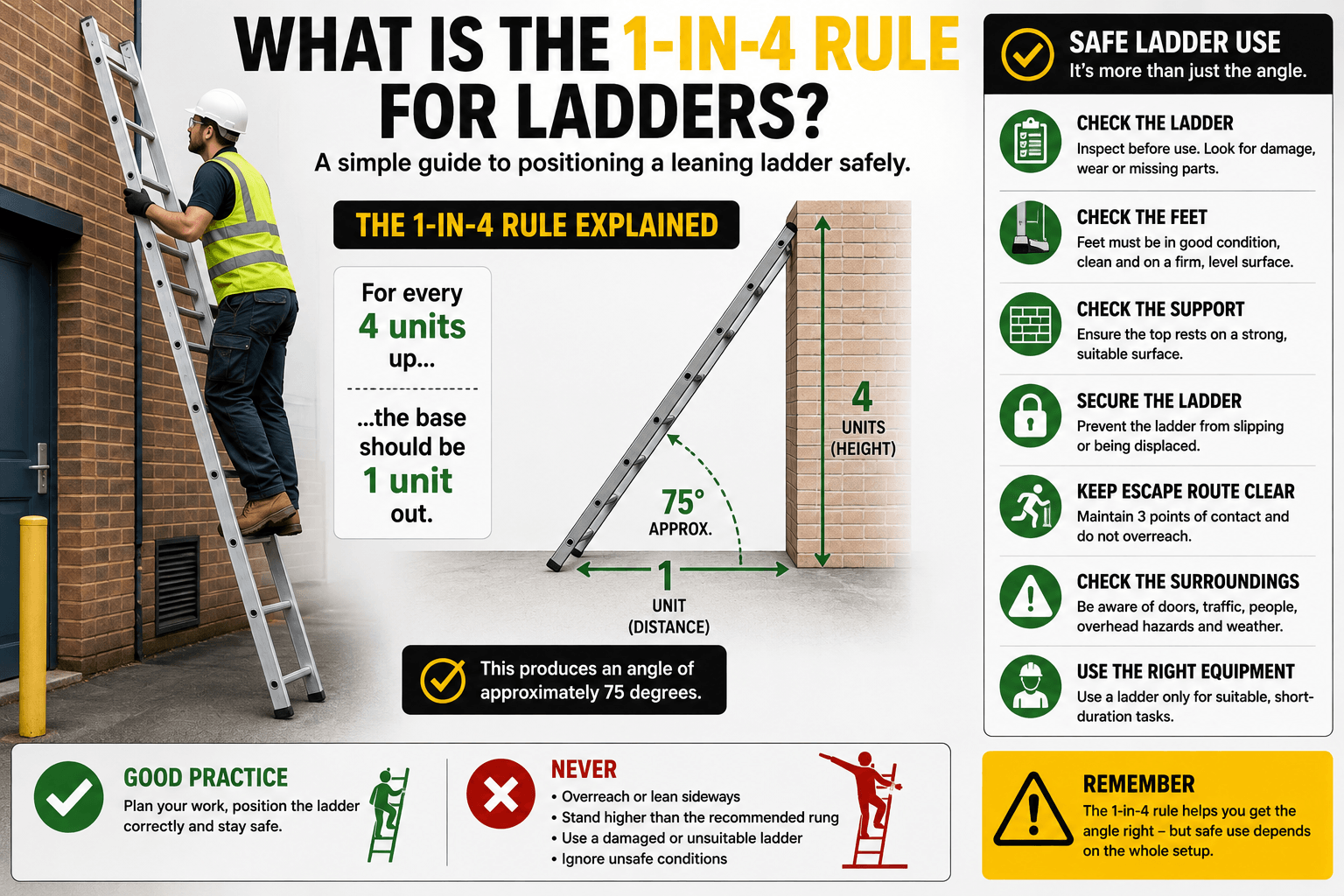
What Is the 1-in-4 Rule for Ladders? –
Getting the angle of a leaning ladder right is an important part of using it safely.
Position the ladder too steeply and there is an increased risk of it falling backwards. Position it too shallow and the feet may be more likely to slide away from the wall.
This is where the 1-in-4 rule for ladders comes in.
It’s a straightforward principle that can help workers position a leaning ladder at an appropriate angle. But like many simple health and safety rules, it can be misunderstood or treated as the only thing that matters.
So what exactly is the 1-in-4 rule, and how should it be used?

What Does the 1-in-4 Ladder Rule Mean?
The 1-in-4 rule relates to the angle of a leaning ladder.
For approximately every four units of vertical height, the base of the ladder should be positioned one unit away from the supporting surface.
For example, if the point where the ladder rests against a wall is approximately four metres high, the foot of the ladder would be approximately one metre out from the wall.
The same principle works with smaller measurements.
If the relevant vertical height is two metres, the base would be approximately half a metre out.
This produces an angle of roughly 75 degrees.
Why Does the Ladder Angle Matter?
A leaning ladder relies on being correctly positioned against a suitable supporting surface.
If the angle is too shallow, the base of the ladder is further away from the wall than it should be.
This can increase the possibility of the ladder feet slipping outwards.
If the ladder is positioned too vertically, stability can also be compromised.
Using the 1-in-4 principle gives workers a straightforward way to establish an appropriate working angle rather than simply judging it by eye.
Does Following the 1-in-4 Rule Make a Ladder Safe?
Not by itself.
Correct angle is only one part of safe ladder use.
A ladder positioned at approximately the right angle could still be unsafe because:
- It is damaged.
- The ground is unstable.
- The feet are contaminated or worn.
- The supporting surface is unsuitable.
- The ladder could be struck by a door.
- Vehicles or pedestrians could collide with it.
- The worker is overreaching.
- The ladder is unsuitable for the task.
The 1-in-4 rule should therefore be treated as part of safe ladder positioning rather than a complete ladder safety assessment.
Check the Ground Before Positioning the Ladder
Before worrying about the angle, consider what the ladder is standing on.
The surface needs to be sufficiently firm and stable.
Problems can arise from surfaces that are:
- Uneven.
- Slippery.
- Soft.
- Contaminated.
- Fragile.
- Sloping.
Workers shouldn’t improvise by placing loose materials beneath ladder feet simply to compensate for an unsuitable surface.
The ladder needs a secure foundation.
What Is the Ladder Leaning Against?
The upper supporting surface matters too.
A worker shouldn’t simply lean a ladder against the nearest convenient object.
Consider whether the surface is sufficiently strong and stable to support the ladder.
Particular care may be necessary around features such as glazing, fragile surfaces, gutters or other building components that aren’t suitable ladder supports.
Correct angle won’t compensate for an unsuitable support.
Should a Leaning Ladder Be Secured?
Where a leaning ladder is used, appropriate measures should be taken to prevent it slipping.
Depending on the circumstances, this can involve securing the ladder appropriately.
Workers should understand the correct procedures for the equipment they use and follow the manufacturer’s instructions.
Simply relying on somebody standing at the bottom of a ladder shouldn’t automatically be treated as the preferred solution where more effective means of securing it are reasonably practicable.
What About Ladder Feet?
The condition of the ladder feet can have a significant effect on stability.
Before using the ladder, check for issues such as:
- Missing feet.
- Excessive wear.
- Damage.
- Mud.
- Oil.
- Other contamination.
A ladder positioned at the correct 1-in-4 angle can still slip if its feet cannot grip the supporting surface effectively.
This is one reason pre-use checks are so important.
Don’t Forget the Condition of the Ladder
Employees should check a ladder before using it.
Problems can involve components including:
- Stiles.
- Rungs.
- Feet.
- Fixings.
- Locks and hinges where applicable.
A damaged ladder shouldn’t simply be used more carefully.
If a defect could affect safe use, the equipment should be taken out of service in accordance with the organisation’s procedures.
That also helps prevent somebody else from unknowingly using it later.
The 1-in-4 Rule Doesn’t Apply to Stepladders in the Same Way
The 1-in-4 principle relates to leaning ladders.
A stepladder is designed differently and is generally self-supporting when correctly opened and positioned.
Workers shouldn’t try to apply leaning-ladder rules indiscriminately to every type of ladder.
They need to understand the equipment they are actually using.
For stepladders, considerations include ensuring they are correctly opened, appropriately positioned and that any locking mechanisms are properly engaged.
Avoid Overreaching
Once a ladder has been carefully positioned, it can be tempting to leave it there for the entire job.
This becomes a problem when the worker needs to reach an area beyond their comfortable working position.
Instead of climbing down and moving the ladder, they may stretch sideways.
Overreaching can destabilise the ladder and increase the risk of a fall.
If the work cannot be comfortably reached while maintaining a stable position, the worker should climb down and reposition the equipment.
Consider What Is Happening Around the Ladder
A ladder isn’t used in isolation from the rest of the workplace.
An otherwise suitable setup could become unsafe if someone opens a nearby door or a vehicle passes through the working area.
Before starting, consider:
- Doors.
- Pedestrian routes.
- Vehicle movements.
- Other workers.
- Overhead hazards.
- Changes in ground level.
- Weather conditions for outdoor work.
Where necessary, suitable precautions should be introduced to protect the work area.
Is a Ladder the Right Equipment for the Job?
Knowing how to position a ladder correctly doesn’t mean a ladder is automatically the correct choice.
Before using one, consider the nature and duration of the task.
Ladders are generally appropriate for lower-risk, relatively short-duration work where a risk assessment indicates their use is suitable.
If the task requires prolonged work, significant sideways force, extensive movement or handling bulky materials, another form of access equipment may provide a more suitable working platform.
The first question shouldn’t be, “What angle should I put the ladder at?”
It should be, “Is a ladder suitable for this task?”
Why Ladder Safety Training Matters
The 1-in-4 rule is simple enough to remember.
But effective Ladder Safety Training needs to put that rule into context.
Employees should understand subjects including:
- Selecting appropriate access equipment.
- Pre-use ladder checks.
- Safe positioning.
- The 1-in-4 rule.
- Preventing ladders from slipping.
- Maintaining a stable working position.
- Avoiding overreaching.
- Recognising unsuitable conditions.
Training can help employees understand why these precautions matter rather than simply memorising a list of rules.

Flexible Ladder Safety Training
Businesses may need to provide Ladder Safety Training when new employees join, responsibilities change or existing knowledge needs refreshing.
Ladder Safety Training supplied on USB provides a reusable resource for delivering training in-house.
The USB contains training videos, question and answer test sheets, certificate templates and training record templates. It can be accessed using a compatible PC, laptop or Mac and reused whenever additional employees require training.
Online Ladder Safety Training provides another option for individual employees or businesses with staff working across different locations.
Final Thoughts
The 1-in-4 rule provides a simple way of remembering the appropriate angle for positioning a leaning ladder.
For approximately every four units of vertical height, position the base approximately one unit out from the supporting surface, producing an angle of around 75 degrees.
But getting the angle right doesn’t make every ladder setup safe.
The condition of the ladder, ground surface, upper support, surrounding environment and nature of the task all need to be considered.
Most importantly, workers need to recognise when a ladder isn’t the appropriate equipment for the job.
The 1-in-4 rule is a useful part of ladder safety.
It isn’t a substitute for it.
