
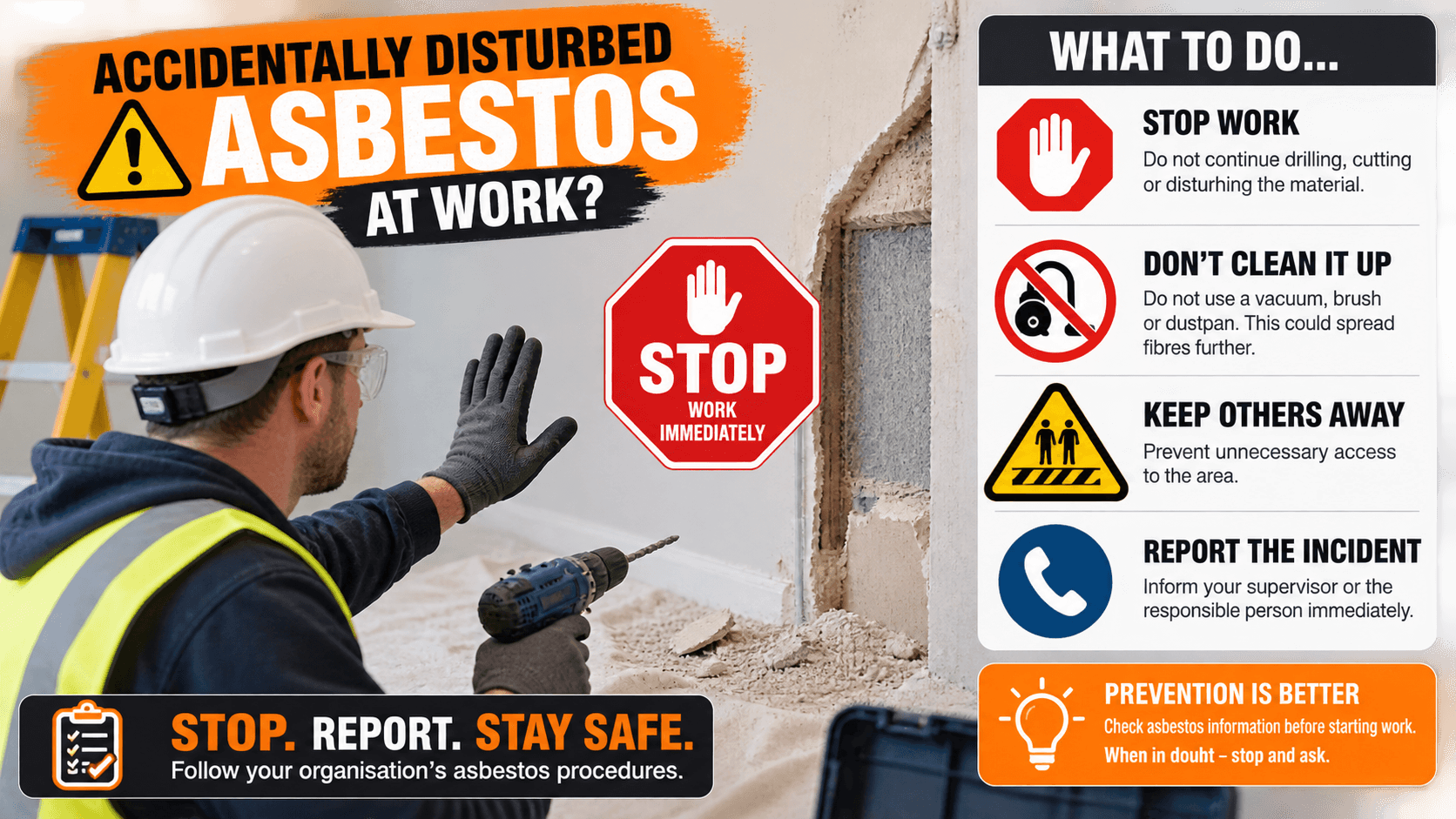
Accidentally Disturbed Asbestos at Work –
Drilling a wall, removing a panel or lifting old flooring can be routine work for maintenance staff and tradespeople.
But what happens if the material being worked on unexpectedly turns out to contain asbestos?
Discovering or suspecting that asbestos-containing material has been accidentally disturbed can be alarming. The actions taken immediately afterwards are important because continuing to work could potentially spread asbestos fibres further.
Employees who may encounter asbestos need to understand a fundamental principle:
If you unexpectedly encounter or disturb material that you believe could contain asbestos, stop work and follow the appropriate procedures.

Stop Work Immediately
If asbestos is suspected, don’t continue drilling, cutting, removing or otherwise disturbing the material.
Continuing the task could cause additional fibre release.
The employee should stop what they are doing and avoid unnecessary further disturbance of the affected area.
This is one of the most important lessons of Asbestos Awareness Training.
Workers aren’t expected to identify asbestos with certainty simply by looking at a material. They need to recognise circumstances where asbestos could potentially be present and know when they should stop.
Don’t Try to Clean It Up Yourself
An employee who sees dust or debris may instinctively reach for a vacuum cleaner, brush or dustpan.
That can be the wrong response where asbestos may be involved.
Attempting to clean contaminated material without the appropriate equipment, controls and competence could cause fibres to become more widely dispersed.
Ordinary vacuum cleaners shouldn’t be used to clean up suspected asbestos debris.
Employees should instead follow the organisation’s emergency procedures and seek appropriate specialist advice.
Keep Other People Away
Where suspected asbestos has been disturbed, unnecessary access to the affected area should be prevented.
Other employees may be unaware of what has happened and could enter the area, walk through debris or carry contamination elsewhere.
The appropriate response will depend on the circumstances, but controlling access can help prevent further disturbance while the situation is assessed.
Employees should know who they need to contact and how the area should be managed following a suspected asbestos incident.
Report the Incident
Workers should report suspected asbestos disturbance promptly to the appropriate person.
Depending on the organisation, this could be a:
- Supervisor.
- Manager.
- Health and safety representative.
- Facilities manager.
- Building manager.
- Responsible person for asbestos management.
The organisation can then determine what further action is necessary.
Employees shouldn’t simply decide for themselves that the amount of material disturbed was too small to matter.
Don’t Assume You Can Recognise Asbestos by Sight
One of the reasons accidental disturbance occurs is that asbestos-containing materials aren’t always obvious.
Asbestos was incorporated into numerous building products, and visual appearance alone generally isn’t sufficient to establish whether a particular material contains asbestos.
Potential asbestos-containing materials in older buildings can include products such as:
- Insulation board.
- Pipe and boiler insulation.
- Sprayed coatings.
- Textured coatings.
- Cement products.
- Floor tiles.
- Roofing products.
- Certain gaskets and seals.
This doesn’t mean every old building material contains asbestos.
It means employees whose work could disturb building materials need appropriate information before starting work.
Check Before You Drill, Cut or Remove
Prevention is considerably better than dealing with an accidental disturbance.
Before intrusive maintenance or installation work begins, workers need access to appropriate information about asbestos risks.
Depending on the premises and work involved, this may include information from an asbestos register, survey or other relevant documentation.
However, employees also need to understand the limitations of the information available to them.
They shouldn’t simply assume an area is asbestos-free because they haven’t personally seen a warning label.
Who Is Particularly at Risk of Accidentally Disturbing Asbestos?
Asbestos Awareness Training can be particularly relevant to people whose work involves disturbing the fabric of buildings.
This may include:
- Electricians.
- Plumbers.
- Heating engineers.
- Joiners and carpenters.
- Builders.
- Painters and decorators.
- Roofers.
- Maintenance workers.
- Fire and security installers.
- Telecoms engineers.
- Facilities personnel.
These workers may drill, cut, remove panels, enter ceiling voids or carry out other activities that could disturb concealed materials.
The relevant question isn’t simply someone’s job title.
It is whether their work could foreseeably expose them to asbestos.
What If Asbestos Gets on Your Clothing?
Employees shouldn’t simply brush visible dust from their clothing and continue working.
Where contamination is suspected, appropriate procedures need to be followed to prevent fibres being spread to other areas, vehicles or homes.
The correct response will depend on the nature of the incident.
This is another reason why workers need to report the situation promptly rather than improvising their own clean-up procedure.
What Happens After an Accidental Disturbance?
The employer will need to assess what has happened and determine the appropriate response.
Depending on the circumstances, this could involve obtaining competent specialist advice, identifying or analysing the material, assessing contamination and arranging suitable remedial work.
The incident should also provide an opportunity to investigate why the material was disturbed.
Questions might include:
- Was suitable asbestos information available?
- Was it checked before work started?
- Did the employee understand the information?
- Was the work properly planned?
- Was the employee appropriately trained?
- Had the building or work area changed?
- Were contractors given relevant information?
Understanding how the incident happened can help prevent a recurrence.
Does Asbestos Awareness Training Teach You to Remove Asbestos?
No.
This distinction is essential.
Asbestos Awareness Training is designed to help workers understand asbestos risks and avoid accidentally disturbing asbestos-containing materials.
It does not qualify somebody to carry out work on asbestos.
Employees who knowingly undertake work that could disturb asbestos require the appropriate additional information, instruction and training for the work concerned.
Some higher-risk asbestos work must be undertaken by appropriately licensed contractors.
An Asbestos Awareness certificate should therefore never be interpreted as permission to remove asbestos.
Why ‘Stop and Ask’ Is Such an Important Principle
Employees sometimes feel pressure to finish a task once they have started.
Imagine an engineer drilling through a wall who encounters an unexpected board behind the surface.
Stopping work might delay the job.
Continuing might seem easier.
But if there is uncertainty about the material, stopping and obtaining the appropriate information is the safer approach.
A delayed job can be rescheduled.
Accidental asbestos disturbance cannot simply be undone.
The Role of Asbestos Awareness Training
Effective Asbestos Awareness Training helps employees recognise situations in which they could encounter asbestos and understand the limitations of their role.
Training can cover areas including:
- The health risks associated with asbestos.
- Where asbestos-containing materials may be found.
- Activities that could disturb asbestos.
- Why visual identification is unreliable.
- The importance of asbestos information.
- What to do when suspicious materials are encountered.
- What to do following accidental disturbance.
The objective isn’t to make employees asbestos specialists.
It is to help prevent an ordinary maintenance, installation or refurbishment task from becoming an asbestos exposure incident.
Training New Starters
Businesses employing tradespeople and maintenance staff should consider asbestos awareness when new employees join.
A worker may have considerable experience in their trade but still need appropriate asbestos information and training.
Previous experience shouldn’t automatically be treated as evidence that someone’s knowledge is current.
Employers should consider the work the employee will actually perform and the potential for them to encounter asbestos-containing materials.
Flexible Asbestos Awareness Training
Businesses that regularly employ people who could encounter asbestos may need to provide training to employees at different times.
Asbestos Awareness Training supplied on USB provides a reusable in-house training resource.
The USB contains training videos, question and answer test sheets, certificate templates and training record templates. It can be accessed using a compatible PC, laptop or Mac and reused when additional employees require training.
Online Asbestos Awareness Training provides another option for individual employees or organisations with workers based at different locations.

Final Thoughts
If an employee accidentally disturbs material that could contain asbestos, the priority is to stop work and prevent unnecessary further disturbance.
They shouldn’t continue the task, attempt an ordinary clean-up or simply assume the material is harmless.
The incident should be reported and the organisation’s appropriate procedures followed so that the situation can be properly assessed.
More importantly, businesses should try to prevent accidental disturbance in the first place.
Employees who may encounter asbestos need access to relevant information and sufficient awareness to recognise when something isn’t right.
Sometimes the safest decision a worker can make is also the simplest:
Stop work and ask before going any further.
