
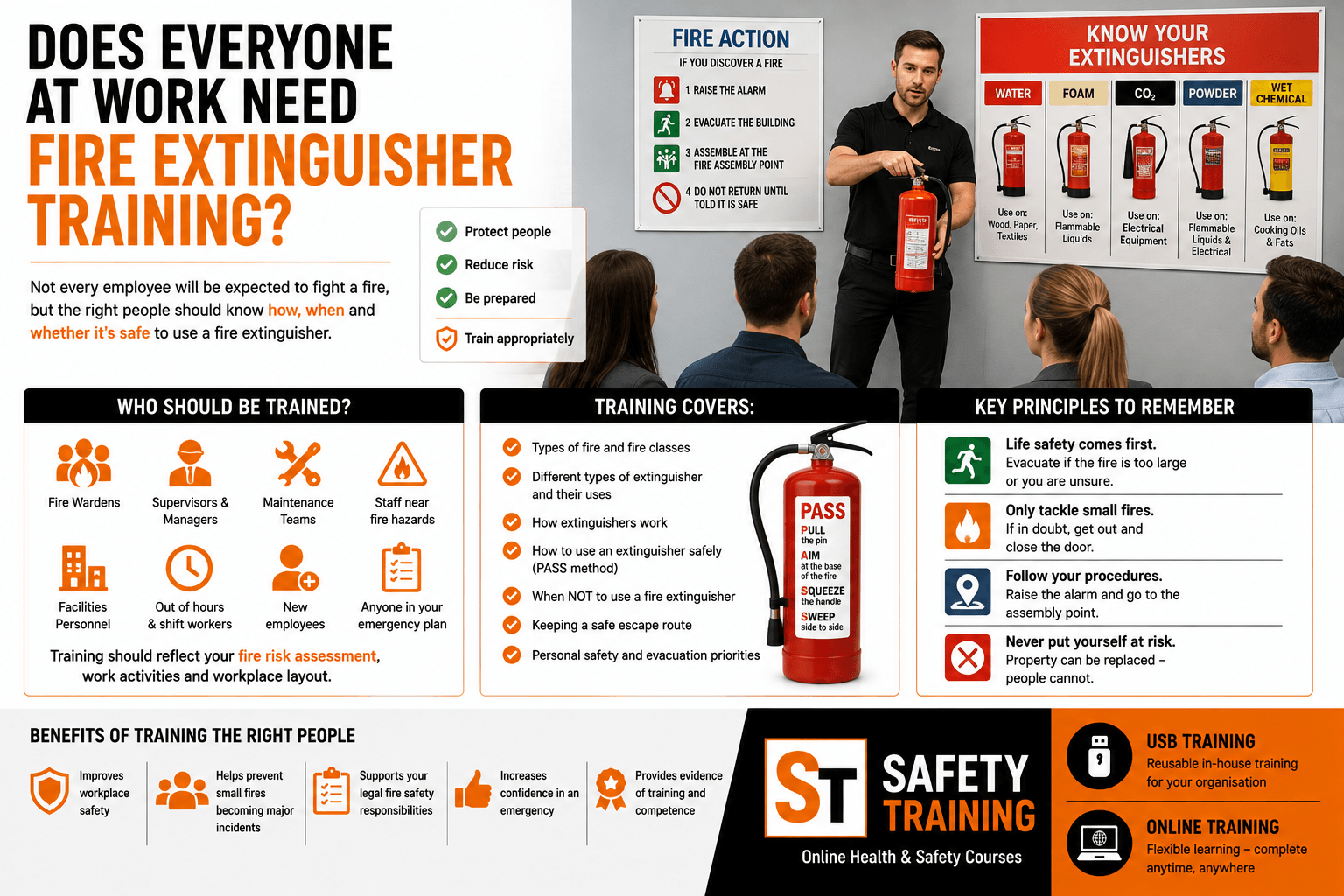
Does Everyone at Work Need Fire Extinguisher Training?
Most UK workplaces have fire extinguishers, but that doesn’t necessarily mean every employee knows how or when to use one.
This raises an important question for employers: does everyone at work need Fire Extinguisher Training?
There isn’t a simple rule stating that every employee in every workplace must be trained to operate a fire extinguisher. However, employers do need appropriate fire safety arrangements, and employees should receive suitable information and instruction relevant to the risks they may encounter.
For many businesses, ensuring an appropriate number of employees understand the safe use of fire extinguishers can form an important part of those arrangements.
Should Employees Be Expected to Fight a Fire?
No employee should assume that they are expected to put themselves at risk to save property.
The priority when a fire is discovered is life safety.
Depending on the circumstances, this will normally involve raising the alarm, following the organisation’s emergency procedures and evacuating the building.
Portable fire extinguishers are intended for dealing with appropriate fires at an early stage when it is safe to do so. They aren’t a substitute for evacuation or the Fire and Rescue Service.
Training should make this distinction clear.
Why Have Fire Extinguishers If Staff Can’t Use Them?
Simply mounting extinguishers on walls doesn’t ensure that they will be used correctly during an emergency.
An untrained employee may:
- Select the wrong extinguisher.
- Attempt to tackle a fire that is already too large.
- Put themselves between the fire and their escape route.
- Stand too close to the fire.
- Use the equipment incorrectly.
- Remain in the building for too long.
Training helps employees understand not only how an extinguisher works, but also the circumstances in which attempting to use one would be inappropriate.
Knowing when to evacuate is every bit as important as knowing how to operate the equipment.
Does Every Employee Need Training?
The appropriate approach will depend on the individual workplace.
Factors to consider include:
- The findings of the fire risk assessment.
- The number of employees.
- The type of work undertaken.
- The fire hazards present.
- The size and layout of the premises.
- Shift patterns.
- The number of trained Fire Wardens.
- The organisation’s emergency procedures.
A small office presents different risks from a manufacturing facility, warehouse, commercial kitchen or workshop.
Employers should therefore base training arrangements on actual workplace risks rather than adopting a universal approach.
Who Might Particularly Benefit From Fire Extinguisher Training?
Depending on the organisation, suitable training may be particularly relevant for:
- Fire Wardens.
- Supervisors.
- Managers.
- Facilities personnel.
- Maintenance teams.
- Employees working around particular fire hazards.
- Staff working outside normal hours.
- Employees designated within the organisation’s emergency arrangements.
Some businesses may choose to train a broader proportion of their workforce so that appropriate knowledge isn’t restricted to a small number of individuals.
What Should Fire Extinguisher Training Teach?
Good Fire Extinguisher Training shouldn’t simply teach someone to pull a pin and operate a handle.
Employees also need to understand the limitations of portable firefighting equipment.
Training can cover areas such as:
- Different classes of fire.
- Common types of extinguisher.
- Extinguisher identification.
- Selecting suitable equipment.
- Basic operating principles.
- Maintaining a safe escape route.
- Recognising when a fire shouldn’t be tackled.
- Personal safety.
- Evacuation priorities.
The objective isn’t to turn employees into firefighters.
It is to give them sufficient knowledge to make safer decisions during the early stages of an emergency.
Why Choosing the Correct Extinguisher Matters
Different extinguishers contain different extinguishing agents because not all fires behave in the same way.
For example, equipment commonly encountered in UK workplaces includes:
- Water extinguishers.
- Foam extinguishers.
- Carbon dioxide (CO₂) extinguishers.
- Dry powder extinguishers.
- Wet chemical extinguishers.
The appropriate extinguisher depends on the materials involved and the specific environment.
Using inappropriate firefighting equipment can create additional hazards rather than solving the problem.
Training helps employees recognise these differences before they are faced with the pressure of a genuine emergency.
What About New Employees?
Fire safety should form part of the information provided to new starters.
Employees need to understand matters such as:
- How to raise the alarm.
- What the fire alarm sounds like.
- Their evacuation route.
- Where the assembly point is.
- Who has specific fire safety responsibilities.
Where an employee is also expected to understand the use of portable fire extinguishers, suitable training should be provided rather than assuming knowledge from a previous job.
Don’t Forget Shift and Lone Workers
Businesses operating evenings, nights and weekends should consider who is actually present at those times.
Having several employees trained in extinguisher use is of limited value if they all work Monday to Friday during office hours.
Training arrangements should reflect real staffing patterns.
This can be particularly relevant to warehouses, factories, hotels, care environments and other organisations operating across extended hours.
Fire Extinguisher Training and Fire Warden Training
The two subjects are related but shouldn’t automatically be treated as identical.
Fire Warden Training focuses more broadly on the role of the Fire Warden and workplace fire procedures.
Fire Extinguisher Training concentrates specifically on portable firefighting equipment, the types of extinguisher available and the principles surrounding their safe use.
Depending on your organisation’s arrangements, some employees may benefit from completing both.
Flexible Fire Extinguisher Training for Businesses
Businesses that need to train multiple employees may benefit from having a reusable training resource available on site.
Fire Extinguisher Training supplied on USB contains the training videos along with question and answer test sheets, certificate templates and training record templates. It can be accessed using a compatible PC, laptop or Mac and used for in-house training whenever required.
This can be particularly useful for organisations with regular new starters or employees working across different shifts.
Online Fire Extinguisher Training provides another option where employees need to complete their training individually or from different locations.

Final Thoughts
Not every employee necessarily needs to become responsible for tackling a workplace fire.
What matters is that businesses have suitable fire safety arrangements based on their particular risks and that employees understand what is expected of them during an emergency.
Where workers may be expected to consider using portable firefighting equipment, appropriate Fire Extinguisher Training can help them recognise different extinguishers, understand their limitations and make safer decisions.
Most importantly, employees should understand one fundamental principle:
If attempting to use an extinguisher could put them in danger, they should evacuate rather than fight the fire.
