
Fire Warden vs Fire Marshal –
If you’re responsible for fire safety training within a UK business, you’ve probably encountered both the terms “Fire Warden” and “Fire Marshal”.
Are they two different jobs? Does a workplace need both? Does one have greater responsibility than the other?
The terminology can cause unnecessary confusion.
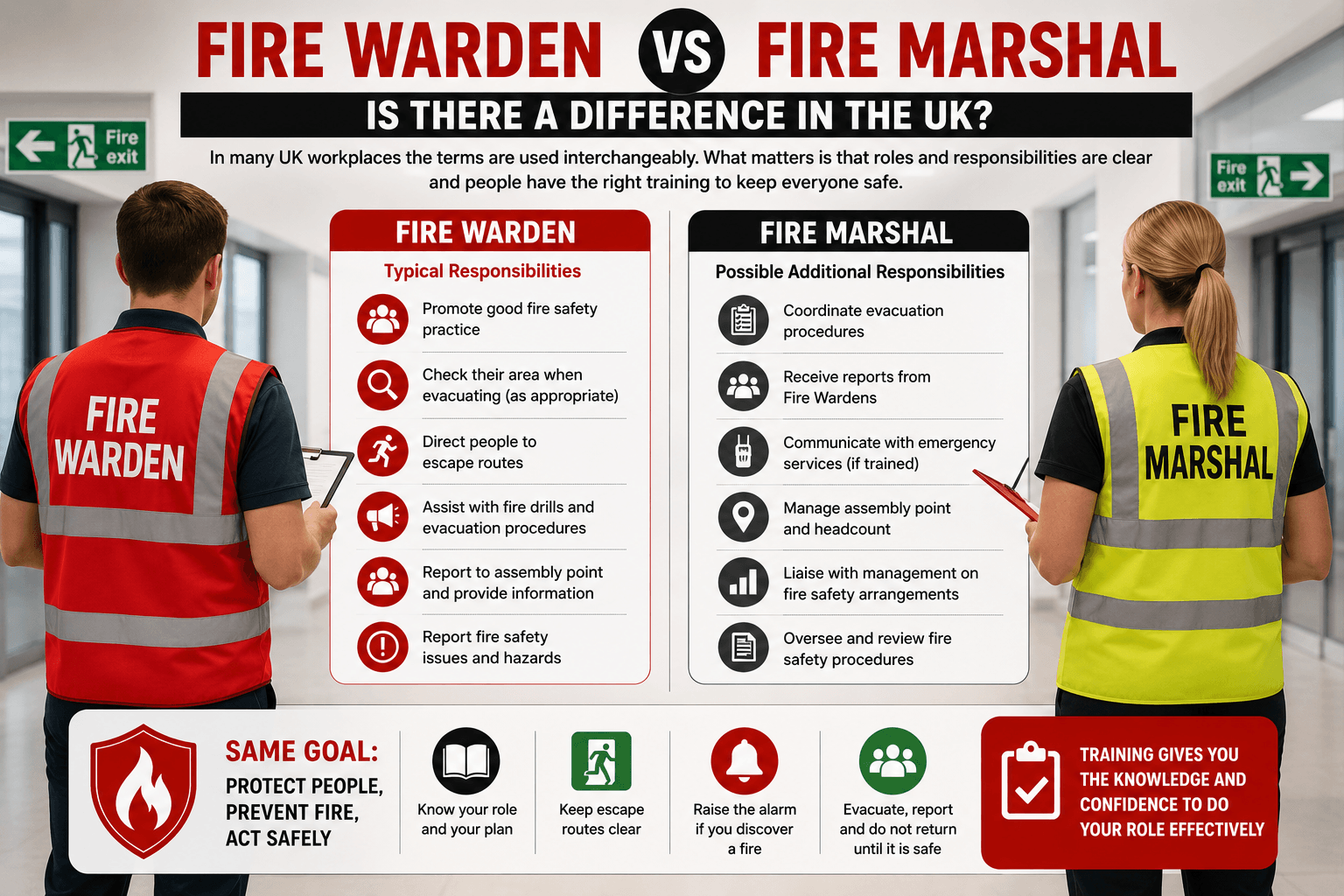
In many UK workplaces, Fire Warden and Fire Marshal are simply different names used for employees who have been given specific responsibilities to assist with workplace fire safety and evacuation.
However, individual organisations may choose to use the titles differently.
What matters isn’t the wording printed on someone’s high-visibility vest. It’s that responsibilities are clearly defined and the people carrying them out have suitable information, instruction and training.
Is a Fire Warden the Same as a Fire Marshal?
There isn’t a universal legal distinction that means somebody called a Fire Marshal must perform one particular set of duties while a Fire Warden performs another.
The terms are commonly used interchangeably.
One business might call all its designated employees Fire Wardens, while another organisation performing essentially the same functions may call them Fire Marshals.
Some larger organisations choose to use both titles and create their own distinction between the roles.
For example, they might appoint Fire Wardens to individual areas and a Fire Marshal to coordinate evacuation information.
That can be a perfectly workable arrangement, but it is an organisational decision rather than a universal definition that applies to every UK workplace.

What Does a Fire Warden Actually Do?
The precise responsibilities of a Fire Warden should reflect the organisation’s fire safety arrangements.
Their duties may include activities both during normal working conditions and during an emergency.
Depending on the workplace, a Fire Warden may help with:
- Encouraging good fire safety practices.
- Reporting fire safety concerns.
- Checking designated areas during an evacuation where appropriate.
- Directing people towards escape routes.
- Helping employees understand evacuation procedures.
- Supporting fire drills.
- Reporting information at the assembly point.
- Helping prevent people from unnecessarily re-entering the building.
The role should be clearly defined so employees know exactly what is expected of them.
What Might a Fire Marshal Do?
Where an organisation uses “Fire Marshal” as a separate title, it may give that person additional coordination responsibilities.
For example, a Fire Marshal might receive information from several Fire Wardens at an assembly point.
However, this isn’t a standard arrangement that every employer must adopt.
Another business might call the people performing exactly those duties Fire Wardens.
This is why employers shouldn’t become too focused on the terminology.
The responsibilities are more important than the title.
Does a Business Need Fire Wardens?
Employers and other responsible persons need suitable arrangements for dealing with fire emergencies.
The number of people required to assist with those arrangements will depend on the circumstances of the premises.
Factors can include:
- The size of the workplace.
- Number of employees.
- Building layout.
- Fire risks.
- Number of floors.
- Shift patterns.
- Working hours.
- People who may require assistance.
- Holiday and sickness cover.
A small workplace operating from straightforward premises may require a different arrangement from a large warehouse, hotel, factory or multi-storey office.
The organisation’s fire risk assessment should inform the arrangements.
Don’t Appoint Someone Without Explaining the Role
Simply telling an employee that they are now the Fire Warden isn’t sufficient.
They need to understand what the role involves.
Without suitable training, an employee could have entirely the wrong idea about their responsibilities.
They might assume, for example, that being a Fire Warden means they are expected to fight a fire.
Alternatively, they may believe they should search every part of a burning building before leaving.
Neither assumption should be allowed to develop simply because responsibilities haven’t been properly explained.
Are Fire Wardens Expected to Fight Fires?
Being appointed as a Fire Warden doesn’t turn an employee into a firefighter.
The primary objective during a workplace fire is protecting life and ensuring the emergency arrangements are followed.
Whether particular employees receive separate Fire Extinguisher Training will depend on the organisation’s arrangements and risk assessment.
A Fire Warden should never assume their title requires them to put themselves in danger attempting to save property.
Their training should make the limits of their role clear.
Should Fire Wardens Search a Building?
This is another area where responsibilities need to be properly defined.
Some workplace evacuation arrangements may allocate particular areas for Fire Wardens to check as they leave, where it is safe and appropriate to do so.
That is very different from expecting an employee to conduct a dangerous search of a smoke-filled or burning building.
Fire Wardens shouldn’t put themselves at unnecessary risk or delay their own evacuation in unsafe conditions.
Workplace-specific procedures should explain exactly what employees are expected to do.
What Happens at the Assembly Point?
Fire Wardens can have useful responsibilities after leaving the building.
Depending on the organisation’s arrangements, they may need to report information concerning their designated area.
Larger organisations may have a system where information from several Fire Wardens is passed to a coordinator.
This is one situation where a business might choose to use the title Fire Marshal for the person coordinating that information.
Again, the title itself is less important than having a procedure that everyone understands.
Fire Wardens Need Workplace-Specific Information
General Fire Warden Training provides knowledge about fire safety and the responsibilities associated with the role.
But employees also need to understand arrangements specific to their own workplace.
These may include:
- What the fire alarm sounds like.
- Escape routes.
- Alternative escape routes.
- Assembly points.
- Areas allocated to individual Wardens.
- Reporting procedures.
- Arrangements for visitors.
- Arrangements for people requiring assistance.
A generic course can’t tell somebody which staircase to use in their particular office.
Employers therefore need to combine appropriate training with information about their own premises and procedures.
What About Holidays and Sickness?
A fire safety arrangement that relies entirely on one particular employee can quickly fail when that person isn’t at work.
Businesses should consider foreseeable absences.
Fire Warden provision may need to cover:
- Annual leave.
- Sickness.
- Meetings away from the workplace.
- Remote working.
- Different shifts.
- Part-time working.
- Staff turnover.
This is particularly relevant as hybrid working becomes more common.
Having ten trained Fire Wardens on an employee list doesn’t necessarily mean ten are present on any particular day.
Fire Warden or Fire Marshal Training?
If your organisation uses the term Fire Marshal rather than Fire Warden, the different terminology doesn’t necessarily mean you need an entirely different type of basic fire safety course.
The important question is whether the training covers the knowledge required for the responsibilities the employee will perform.
Where an organisation gives somebody additional or specialist responsibilities, it should consider whether further information or training is required for those duties.
Employers should focus on competence rather than simply matching the wording of a course title to a job title.
Why Fire Warden Training Matters
Fire Warden Training can help designated employees understand subjects such as:
- Common causes of workplace fires.
- Fire prevention.
- Fire safety arrangements.
- Emergency procedures.
- Evacuation principles.
- The role of a Fire Warden.
- Actions during a fire.
- The importance of keeping escape routes available.
It can also correct potentially dangerous misconceptions about what the role requires.
The objective is to give designated employees the knowledge to support the organisation’s fire safety arrangements without encouraging them to take unnecessary risks.
Flexible Fire Warden Training for Businesses
Businesses may need to train replacement Fire Wardens when employees leave, change roles or alter their working patterns.
Having training readily available can make this easier to manage.
Fire Warden Training supplied on USB provides a reusable in-house training resource containing training videos, question and answer test sheets, certificate templates and training record templates.
The USB can be accessed using a compatible PC, laptop or Mac and reused when additional employees require training.
Online Fire Warden Training provides another option for employees who need to complete their training individually or from different locations.

Final Thoughts
For most UK businesses, there is little value in becoming preoccupied with whether an employee should technically be called a Fire Warden or a Fire Marshal.
The terms are often used interchangeably, although individual organisations may choose to define separate responsibilities for each.
What matters is much more practical.
Employers need appropriate fire safety arrangements, enough suitably trained people to support those arrangements and clear responsibilities that employees understand.
Whether the badge says “Fire Warden” or “Fire Marshal”, the employee needs to know exactly what they are expected to do before the fire alarm sounds.
