
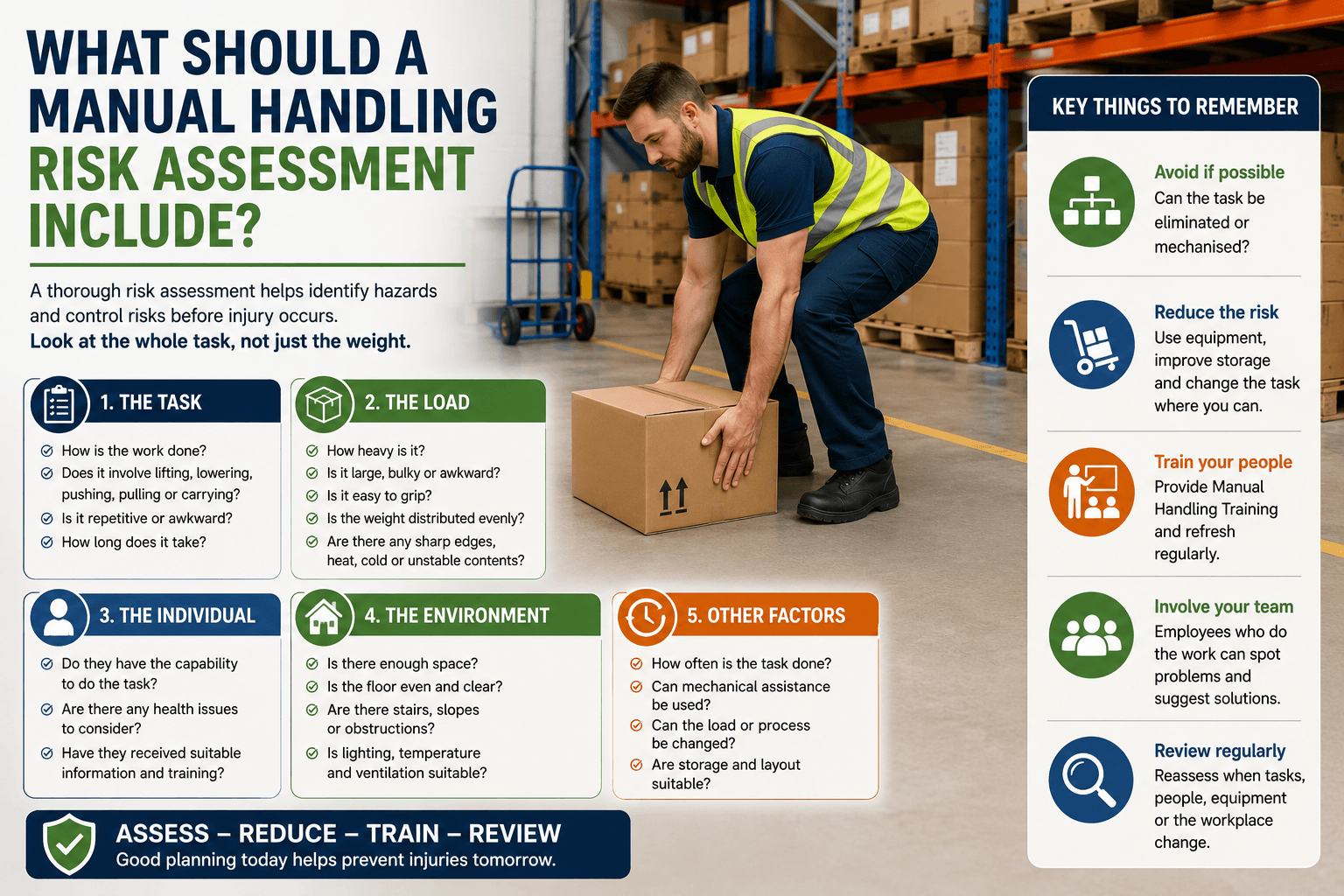
What Should a Manual Handling Risk Assessment Include?
Lifting a box, moving stock, pushing a trolley or carrying equipment may seem like ordinary workplace activities. However, when manual handling tasks are poorly planned, they can expose employees to avoidable risks.
This is why employers need to consider manual handling as part of their workplace risk management.
But what should a Manual Handling Risk Assessment actually include?
A useful assessment needs to consider much more than the weight of the object being moved. The task, load, working environment and capabilities of the people involved can all affect the level of risk.
When Is a Manual Handling Risk Assessment Needed?
The first principle of managing manual handling is to consider whether hazardous manual handling can be avoided.
If a load doesn’t need to be manually moved at all, removing the activity can remove the associated manual handling risk.
Where potentially hazardous manual handling cannot reasonably be avoided, employers need to assess the risk and consider appropriate measures to reduce it.
This could apply to activities involving:
- Lifting.
- Lowering.
- Carrying.
- Pushing.
- Pulling.
- Supporting or moving loads.
Manual handling therefore covers considerably more than simply picking up heavy boxes.
Start With the Task
One of the first things to consider is how the work is actually performed.
Two employees might move identical objects but face very different risks because of the way their tasks are organised.
Consider whether the activity involves:
- Lifting from floor level.
- Reaching above shoulder height.
- Twisting.
- Stooping.
- Repetitive movements.
- Long carrying distances.
- Holding a load for an extended period.
- Sudden or unpredictable movement.
- Frequent lifting throughout a shift.
The assessment should reflect what happens in practice rather than how the task is assumed to be performed.
Consider the Load
Weight is clearly relevant, but it shouldn’t be considered in isolation.
A relatively light object can still be awkward to handle.
Questions to consider include:
- How heavy is the load?
- Is it large or bulky?
- Is it difficult to grip?
- Is the weight distributed unevenly?
- Could the contents move unexpectedly?
- Is the load hot, cold or sharp?
- Does its size obstruct the employee’s view?
A compact object with secure handholds may be considerably easier to handle than a large box of exactly the same weight.
Consider the Individual
People have different physical capabilities.
A task that one employee performs comfortably shouldn’t automatically be assumed suitable for everybody else.
An assessment may need to consider relevant individual factors and whether particular employees could be at increased risk.
Employers should also consider whether employees have received suitable information and training for the work they are expected to undertake.
Training can help workers recognise hazards, use safer handling principles and understand when they should ask for assistance.
Assess the Working Environment
The environment in which a load is moved can substantially alter the risk.
Imagine carrying the same box in two different workplaces.
In the first, the employee moves it across a clear, dry and level floor.
In the second, they carry it along a narrow route, around obstacles and up a staircase.
The load hasn’t changed.
The manual handling risk has.
Environmental considerations can include:
- Restricted space.
- Uneven flooring.
- Slippery surfaces.
- Stairs and changes in level.
- Poor lighting.
- Obstacles.
- Extreme temperatures.
- Insufficient room to adopt a suitable position.
These factors shouldn’t be overlooked simply because the object itself appears straightforward to handle.
Think About Frequency and Duration
How often employees perform the task also matters.
Moving a particular load once a week isn’t necessarily equivalent to handling the same object dozens or hundreds of times during a shift.
Repetitive manual handling can contribute to fatigue.
As employees become tired, maintaining suitable working practices may become more difficult.
A risk assessment should therefore consider the complete working pattern rather than assessing one lift in isolation.
Can Mechanical Assistance Reduce the Risk?
One of the most effective ways to reduce manual handling demands can be to use suitable equipment.
Depending on the task, this might include:
- Trolleys.
- Sack trucks.
- Pallet trucks.
- Hoists.
- Lifting tables.
- Conveyors.
- Other mechanical handling equipment.
The objective isn’t simply to teach employees to cope with difficult manual handling.
Where reasonably practicable, the task itself should be improved.
Can the Load Be Changed?
Sometimes the solution is surprisingly straightforward.
Could one large load be divided into several smaller loads?
Could packaging incorporate better handholds?
Could frequently used items be stored at a more suitable height?
Could deliveries be positioned closer to where the goods will actually be used?
Small changes to the way work is organised can sometimes reduce manual handling risks substantially.
Review Storage Arrangements
Poor storage can create unnecessary manual handling problems.
Heavy or frequently handled items stored at floor level may repeatedly require employees to bend down.
Items stored too high can encourage reaching and handling above shoulder level.
Employers should consider whether storage arrangements can be redesigned so commonly handled loads are positioned more conveniently.
This can reduce awkward movements before training even becomes relevant.
What About Team Lifting?
Using two people can sometimes help with loads that would be difficult for one employee to handle.
However, team lifting isn’t automatically the solution to every problem.
Employees need to coordinate their movements, and the size or shape of the load may still create difficulties.
Where team handling is used, the task should be planned appropriately and the people involved should understand how they will coordinate the movement.
Mechanical assistance may still provide a better solution in some situations.
Should Employees Be Involved in the Assessment?
Employees who regularly perform a task can provide valuable information about how it works in reality.
They may know that:
- A particular load is difficult to grip.
- A trolley regularly jams.
- A route becomes obstructed.
- Stock is frequently stored in the wrong place.
- A task becomes more difficult during busy periods.
Consulting the people performing the work can help identify practical problems that aren’t immediately obvious from simply observing the task once.
When Should a Manual Handling Assessment Be Reviewed?
A risk assessment shouldn’t be treated as paperwork that is completed once and then forgotten.
A review may be appropriate when:
- The task changes.
- Different loads are introduced.
- New equipment is installed.
- The workplace layout changes.
- Employees report difficulties.
- An accident or near miss occurs.
- Existing control measures appear ineffective.
Changes don’t necessarily need to be dramatic to alter manual handling risk.
Where Does Manual Handling Training Fit In?
Training is an important control measure, but it shouldn’t be used as a substitute for improving a badly designed task.
Teaching an employee good lifting principles doesn’t make an unnecessarily hazardous activity acceptable.
Instead, Manual Handling Training should support wider risk-reduction measures.
Employees can learn about:
- Recognising manual handling hazards.
- Assessing a load before moving it.
- Safer handling principles.
- Maintaining better positioning.
- Avoiding unnecessary twisting and reaching.
- Using mechanical assistance.
- Knowing when to ask for help.
Training is most effective when employees can apply what they learn to tasks that have already been appropriately assessed and organised.
Flexible Manual Handling Training for Employers
Businesses with regular new starters or numerous employees carrying out manual handling may benefit from having training readily available.
Manual Handling Training supplied on USB provides a reusable in-house training resource containing training videos, question and answer test sheets, certificate templates and training record templates.
The USB can be accessed using a compatible PC, laptop or Mac and reused whenever additional employees require training.
Online Manual Handling Training provides another option where individual employees need to complete training remotely or at different times.
This gives businesses flexibility while maintaining a consistent approach to the information employees receive.

Final Thoughts
A Manual Handling Risk Assessment shouldn’t focus exclusively on how many kilograms an employee is lifting.
The task, load, individual and working environment all need to be considered, along with factors such as frequency and duration.
Employers should first look for opportunities to avoid hazardous manual handling and then consider practical ways to reduce the risks that remain.
That might mean changing the task, improving storage, reducing individual loads or introducing mechanical assistance.
Training then provides employees with the knowledge to recognise risks and apply safer working principles.
Effective manual handling management therefore isn’t simply about teaching people how to lift.
It’s about designing and organising work so that employees don’t have to take unnecessary risks in the first place.
