
Is There a Maximum Weight You Can Lift at Work in the UK?
Ask someone how much an employee is legally allowed to lift at work and you’ll often hear a specific figure quoted.
The problem is that workplace manual handling isn’t that simple.
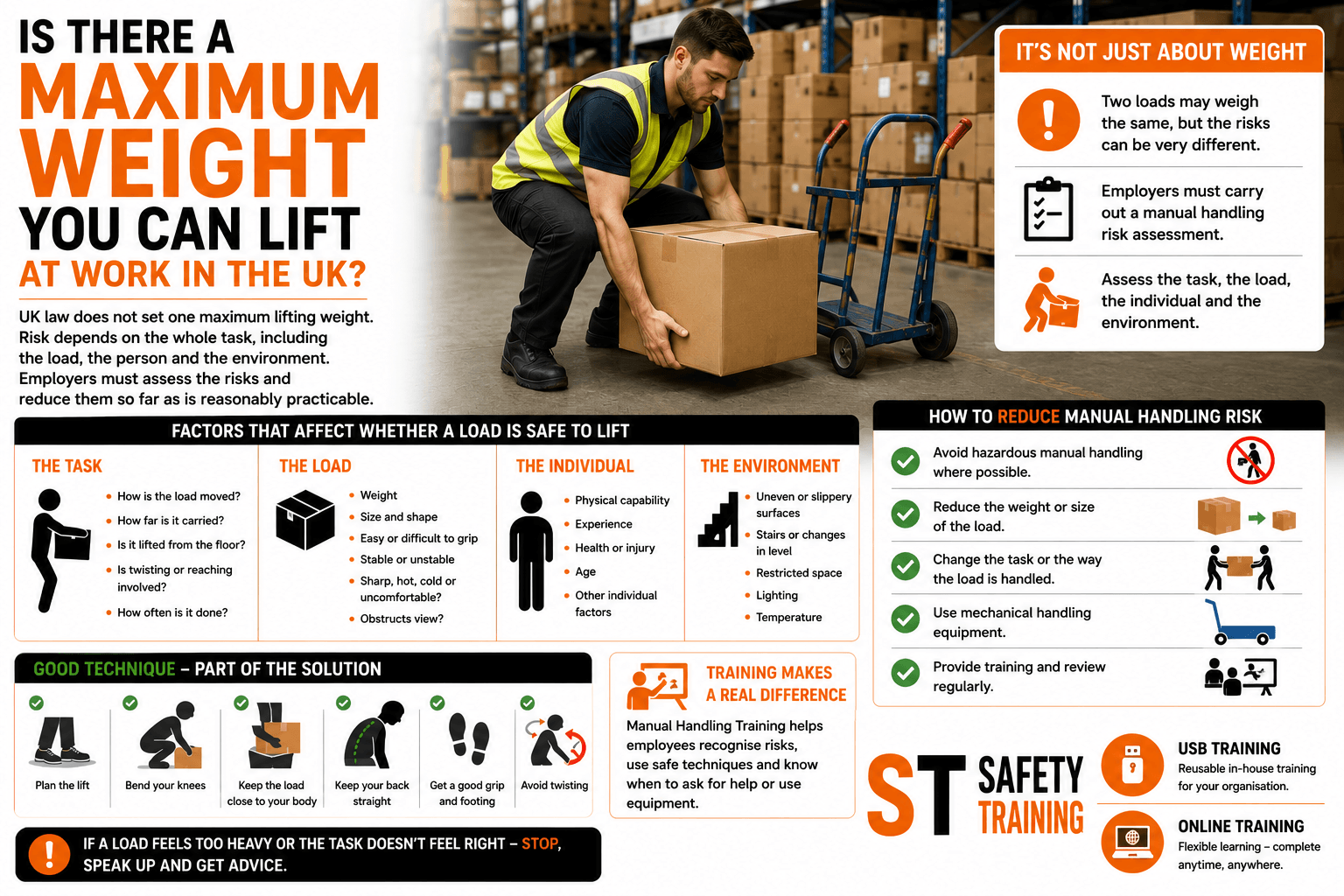
There is no single legal maximum lifting weight that automatically determines whether a load is safe or unsafe for every employee and every task.
Instead, UK employers need to consider the risks associated with the particular manual handling operation.
So rather than asking only “How heavy is it?”, a better question is: “Can this person move this load safely in these circumstances?”
Is There a Legal Maximum Lifting Weight?
UK manual handling legislation doesn’t establish one universal maximum weight that every worker can safely lift.
This makes sense when you consider how different two loads of exactly the same weight can be.
Imagine two boxes that both weigh 15kg.
One is compact, has secure handholds and can be lifted from waist height.
The other is large, awkwardly shaped, difficult to grip and sitting on the floor underneath a shelf.
Although the weight is identical, the second lift could present considerably greater risk.
Weight is important, but it is only one part of assessing a manual handling task.
Why Are Specific Weight Figures Sometimes Quoted?
You may have seen manual handling diagrams containing different weight figures depending on where a load is positioned in relation to the body.
These can be useful as guideline figures when carrying out an initial assessment of relatively straightforward lifting and lowering operations.
However, they shouldn’t be interpreted as legal lifting limits or guarantees that a particular task is safe.
A load being below a guideline figure doesn’t automatically make the activity risk-free.
Employers still need to consider the complete manual handling operation.
What Factors Affect Whether a Load Is Safe to Lift?
A useful way to understand manual handling risk is to consider four broad areas: the task, the load, the individual and the environment.
The Task
Consider what the employee actually needs to do.
Does the task involve:
- Repeated lifting?
- Carrying something over a long distance?
- Twisting?
- Reaching?
- Stooping?
- Lifting from floor level?
- Placing loads above shoulder height?
- Holding a load for an extended period?
A relatively light object can still create problems when the movement required to handle it is awkward or highly repetitive.
The Load
Weight is only one characteristic of the object being moved.
Employers should also consider whether the load is:
- Bulky.
- Difficult to grip.
- Unstable.
- Sharp.
- Hot or cold.
- Likely to move unexpectedly.
- Obstructing the employee’s view.
A large lightweight box can sometimes be more difficult to handle safely than a smaller, heavier object because the worker cannot hold it close to their body or see where they are walking.
The Individual
People aren’t identical.
An employee’s physical capability, experience and other individual factors can influence whether a particular manual handling task is appropriate for them.
This is another reason why applying one maximum weight to an entire workforce can be misleading.
A task shouldn’t simply be declared safe because another employee can perform it without difficulty.
The Working Environment
Where the manual handling takes place can substantially alter the risk.
Consider factors such as:
- Uneven flooring.
- Slippery surfaces.
- Stairs.
- Restricted space.
- Poor lighting.
- Changes in floor level.
- Obstacles.
- Extreme temperatures.
Carrying a box across a clear, level warehouse floor isn’t the same as carrying the identical box up a narrow staircase.
The load hasn’t changed, but the risk has.
What About Repetitive Lifting?
The number of times a load is handled matters too.
An employee lifting something once during a working day faces a different situation from someone repeating the same movement hundreds of times during a shift.
Repetitive handling can contribute to fatigue, and fatigue can affect an employee’s ability to continue performing a task safely.
Manual handling assessments should therefore consider frequency as well as individual load weight.
Should Employees Just Use the Correct Lifting Technique?
Good handling technique is important, but it shouldn’t be used as the solution to every manual handling problem.
Training an employee to lift correctly doesn’t make an unnecessarily hazardous task acceptable.
Employers should first consider whether hazardous manual handling can be avoided.
Where it cannot reasonably be avoided, the risks should be assessed and reduced so far as reasonably practicable.
This might involve:
- Using mechanical handling equipment.
- Reducing the size of individual loads.
- Changing storage arrangements.
- Redesigning the task.
- Reducing carrying distances.
- Using two people where appropriate.
- Improving access to the load.
Training then supports these wider risk-control measures.
When Should Mechanical Assistance Be Considered?
Equipment can sometimes remove or significantly reduce the physical demands placed on employees.
Depending on the workplace, this could include:
- Sack trucks.
- Trolleys.
- Pallet trucks.
- Hoists.
- Lifting tables.
- Conveyors.
- Other mechanical handling equipment.
The appropriate solution will depend on the task.
The important principle is that employees shouldn’t automatically be expected to manually lift something simply because it is physically possible to do so.
Why Manual Handling Training Still Matters
Is There a Maximum Weight You Can Lift at Work in the UK? If there is no universal maximum lifting weight, employees need to understand how to make sensible decisions about the tasks they perform.
Manual Handling Training can help workers understand:
- Common manual handling hazards.
- How to assess a load before moving it.
- Safer lifting and carrying principles.
- The importance of good posture and positioning.
- Why twisting and overreaching can increase risk.
- When to ask for assistance.
- When mechanical equipment may be more appropriate.
- When a task shouldn’t be attempted.
The objective isn’t to teach employees that they can safely lift a particular number of kilograms.
It is to help them recognise and reduce manual handling risks.
What Should an Employee Do if a Load Feels Too Heavy?
They shouldn’t simply attempt the lift because they believe the load is technically below some supposed legal limit.
If an employee has concerns about a manual handling task, they should follow their organisation’s procedures and raise the issue with the appropriate person.
The task may need reassessing.
A different handling method, another employee or suitable equipment could provide a safer solution.
Flexible Manual Handling Training
Is There a Maximum Weight You Can Lift at Work in the UK? Businesses that regularly need to train employees can choose a training format suited to their workforce.
Manual Handling Training supplied on USB provides a reusable resource for delivering training in-house. The package includes training videos, question and answer test sheets, certificate templates and training record templates.
The USB can be accessed on compatible PCs, laptops and Macs, making it particularly useful for businesses with new starters or ongoing refresher training requirements.
Online Manual Handling Training provides an alternative for employees who need to complete their course individually or remotely.

Final Thoughts
There isn’t one legal maximum lifting weight that determines whether every workplace manual handling task is safe.
A number on a box cannot tell you everything you need to know.
The load itself, how frequently it is moved, where it needs to go, the employee carrying it and the environment in which the task takes place can all affect the level of risk.
For employers, the key is to assess manual handling activities properly rather than relying on a supposed universal weight limit.
For employees, effective Manual Handling Training can help develop a much more useful skill: recognising when a manual handling task presents a risk and knowing when a different approach is needed.
