Pushing and Pulling at Work –
When people hear the words “manual handling”, they often picture somebody lifting a heavy box from the floor.
But lifting and carrying are only part of the picture.
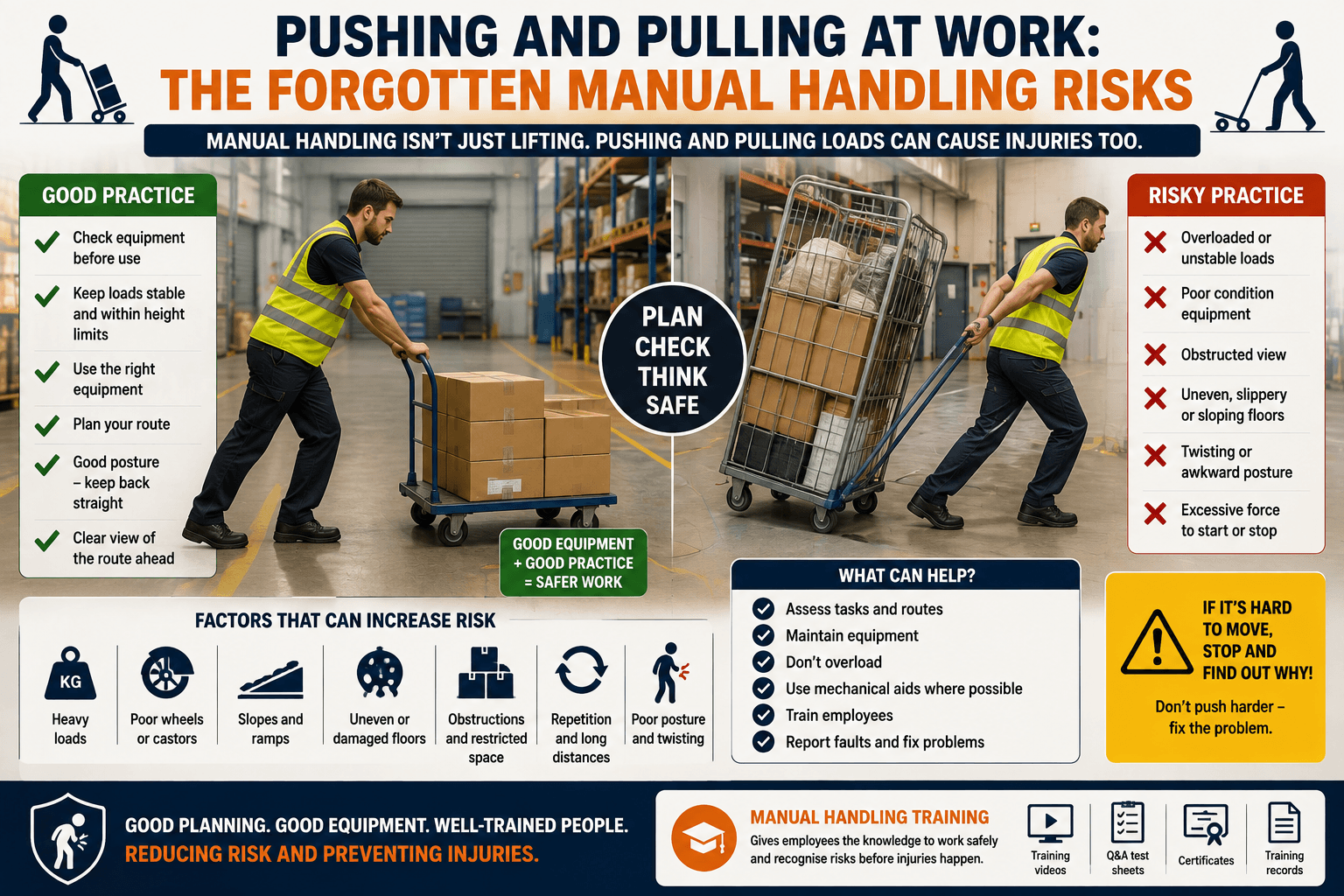
Employees in warehouses, shops, factories, offices, hospitals and many other workplaces regularly push and pull loads. Moving a loaded trolley, manoeuvring a roll cage or repositioning equipment can all involve manual handling.
And because the load remains on wheels or on the floor, it can be easy to underestimate the physical effort involved.
Pushing and pulling can still create a risk of injury and should be considered when employers assess manual handling activities.
Is Pushing and Pulling Classed as Manual Handling?
Yes.
Manual handling isn’t restricted to lifting something with your hands.
The Manual Handling Operations Regulations cover transporting or supporting a load by hand or bodily force. This can include activities involving lifting, lowering, carrying, pushing and pulling.
Examples of pushing and pulling at work can include:
- Moving stock trolleys.
- Manoeuvring roll cages.
- Pushing wheeled bins.
- Moving pallet trucks.
- Repositioning equipment.
- Moving loaded carts.
- Pulling wheeled cases or containers.
- Moving furniture.
- Handling hospital or care equipment.
These tasks need to be considered alongside more obvious lifting activities.
Why Can Pushing a Trolley Be Hazardous?
A trolley makes moving a load easier, but that doesn’t mean the task is automatically low risk.
Several factors can substantially increase the force required to get a trolley moving or keep it under control.
For example, consider a heavily loaded trolley with a damaged wheel.
The employee may need considerable force just to start it moving.
Once moving, they may have difficulty steering it or stopping it.
The trolley is supposed to reduce manual handling demands, but poor condition has potentially created a different problem.
Starting a Load Moving Can Require More Effort
The amount of force needed to start a stationary load moving can be greater than the force required to keep it moving.
This can encourage employees to use sudden, forceful movements when a trolley initially refuses to move.
If an employee repeatedly has to strain against equipment to get it moving, the solution shouldn’t simply be to push harder.
The task, load, equipment and surface should be examined to understand why so much force is required.
Check the Wheels and Castors
Wheels and castors have an enormous influence on how easily handling equipment moves.
Problems can include:
- Damaged wheels.
- Worn castors.
- Debris caught around wheels.
- Poorly maintained bearings.
- Wheels unsuitable for the surface.
- Castors that no longer rotate correctly.
Employees should have a way to report defective handling equipment.
A trolley that has become increasingly difficult to move shouldn’t remain in service indefinitely simply because employees can still force it along.
How Heavy Is the Load?
A wheeled trolley can allow employees to move loads considerably heavier than they could safely carry.
However, there are still limits to what the equipment and employee can manage safely.
Overloading can make equipment:
- Difficult to start moving.
- Harder to steer.
- More difficult to stop.
- Less stable.
- Difficult to control on slopes.
Employees should understand any relevant capacity limits and workplace procedures.
Can the Employee See Where They Are Going?
One frequently overlooked risk occurs when a trolley or roll cage is loaded too high.
The employee may be physically capable of moving it but unable to see the route ahead.
That can increase the risk of:
- Collisions.
- Striking other employees.
- Hitting doors or racking.
- Missing changes in floor level.
- Running into obstructions.
Loads should be arranged so that employees can safely control the equipment and see where they are going.
The Floor Surface Makes a Difference
Moving the same trolley across two different surfaces can require very different levels of effort.
A smooth, level warehouse floor may allow relatively easy movement.
Move the trolley onto an uneven surface, damaged flooring or an incline and the task can change considerably.
Things to consider include:
- Uneven floors.
- Thresholds.
- Ramps.
- Slopes.
- Cracked surfaces.
- Loose materials.
- Wet or slippery floors.
- Changes between different floor coverings.
Employers assessing pushing and pulling activities should look at the complete route rather than examining the trolley in isolation.
Slopes Can Change Everything
A loaded trolley on a slope introduces additional considerations.
When travelling uphill, considerably more force may be required.
When travelling downhill, the problem can be controlling the load rather than getting it moving.
Gravity is now helping the trolley travel in exactly the direction the employee may be trying to restrain it.
The weight, gradient, equipment and employee’s ability to maintain control all need to be considered.
Where a route creates an unacceptable risk, another method of moving the load may be required.
Is It Better to Push or Pull?
Where the task and equipment allow it, pushing can often be preferable to pulling because it may allow the employee to adopt a better position and see the direction of travel more easily.
But this shouldn’t be turned into an absolute rule.
The design of the equipment, available space, route and task all need consideration.
For example, manoeuvring equipment through a restricted area may occasionally require different movements.
The important issue is avoiding unnecessary force and awkward postures.
Handles Matter
Good handling equipment should allow employees to apply force from a suitable position.
Poorly positioned handles can encourage employees to:
- Bend excessively.
- Reach too high.
- Work with awkward wrist positions.
- Twist while pushing.
- Apply force from an inefficient posture.
When purchasing trolleys and similar equipment, usability should therefore be considered alongside load capacity and price.
Don’t Ignore Repetition
Moving one relatively light trolley may present little difficulty.
Moving similar loads repeatedly throughout an eight-hour shift is different.
Frequency and duration can affect manual handling risk.
Repeated pushing and pulling can contribute to fatigue, particularly where employees regularly need substantial force to start, stop or steer loads.
Employers should assess the working pattern rather than looking at one isolated movement.
What About Pallet Trucks?
Manual pallet trucks are widely used for moving palletised goods.
They can significantly reduce the need to manually carry individual items, but their use still needs to be managed appropriately.
Considerations can include:
- Load weight.
- Condition of the pallet truck.
- Condition of the pallet.
- Floor surface.
- Slopes and gradients.
- Space available for manoeuvring.
- Pedestrians and vehicles.
- Employee training and instruction.
The fact that equipment has been provided doesn’t remove the need to assess how it is actually used.
Watch Out for Trapped Hands and Feet
Musculoskeletal injury isn’t the only potential hazard.
Moving equipment can create collision and trapping risks.
Employees may place their hands in vulnerable positions while manoeuvring equipment through narrow gaps or around doors.
Feet can also be at risk from wheels or moving loads.
Workplace layout and handling procedures should therefore provide sufficient space wherever reasonably practicable.
What Happens When a Load Gets Stuck?
A trolley wheel catches on a threshold.
A roll cage refuses to move.
A pallet truck becomes difficult to manoeuvre.
The natural reaction can be to apply substantially more force.
That isn’t always the safest response.
Employees should be encouraged to stop and identify the problem rather than repeatedly jerking, pulling or pushing equipment with increasing force.
The obstruction, equipment or load may need correcting before work continues.
Can Workplace Layout Reduce Pushing and Pulling Risks?
Yes.
Sometimes the best improvement has nothing to do with lifting technique or employee strength.
Consider whether:
- Frequently moved goods can be stored closer to where they are needed.
- Routes can be shortened.
- Thresholds can be removed.
- Damaged flooring can be repaired.
- Doors can be made easier to negotiate.
- Congested areas can be reorganised.
- Suitable mechanical equipment can be introduced.
Changing the workplace can reduce the physical demands placed on employees every day.
Why Manual Handling Training Matters
Employees need to understand that manual handling involves more than lifting.
Manual Handling Training can help workers recognise risks associated with:
- Lifting and lowering.
- Carrying.
- Pushing and pulling.
- Awkward loads.
- Repetitive handling.
- Workplace layout.
- Handling aids.
- Individual capability.
Training can also reinforce an important principle: if equipment requires excessive force to move, employees shouldn’t simply accept that as part of the job.
The problem should be identified and addressed.
Training Should Support Better Working Practices
As with lifting, training isn’t a substitute for suitable equipment and well-designed tasks.
Teaching an employee how to push a trolley doesn’t solve:
- Broken wheels.
- Excessive loads.
- Damaged flooring.
- Inappropriate gradients.
- Poorly positioned handles.
- Badly designed routes.
Employers should first look at how risks can be avoided or reduced.
Training then helps employees understand the remaining risks and use the equipment appropriately.
Flexible Manual Handling Training
Businesses may need to provide Manual Handling Training as employees join, change roles or take on different responsibilities.
Manual Handling Training supplied on USB provides a reusable resource for delivering training in-house.
The USB includes training videos, question and answer test sheets, certificate templates and training record templates. It can be accessed using a compatible PC, laptop or Mac and reused whenever additional employees require training.
Online Manual Handling Training provides another option for individual employees or businesses with workers across different locations.

Final Thoughts
Manual handling isn’t just about picking up heavy objects.
Pushing and pulling trolleys, cages, equipment and other loads can also expose employees to unnecessary physical demands when tasks aren’t properly planned.
The condition of the equipment, weight of the load, floor surface, route, gradients, workplace layout and frequency of the task can all make a significant difference.
Employers should therefore include pushing and pulling activities when assessing manual handling risks.
And employees should understand that when a trolley becomes exceptionally difficult to move, the answer isn’t necessarily to push harder.
Sometimes the safest manual handling technique is to stop and find out why the task is difficult in the first place.
