
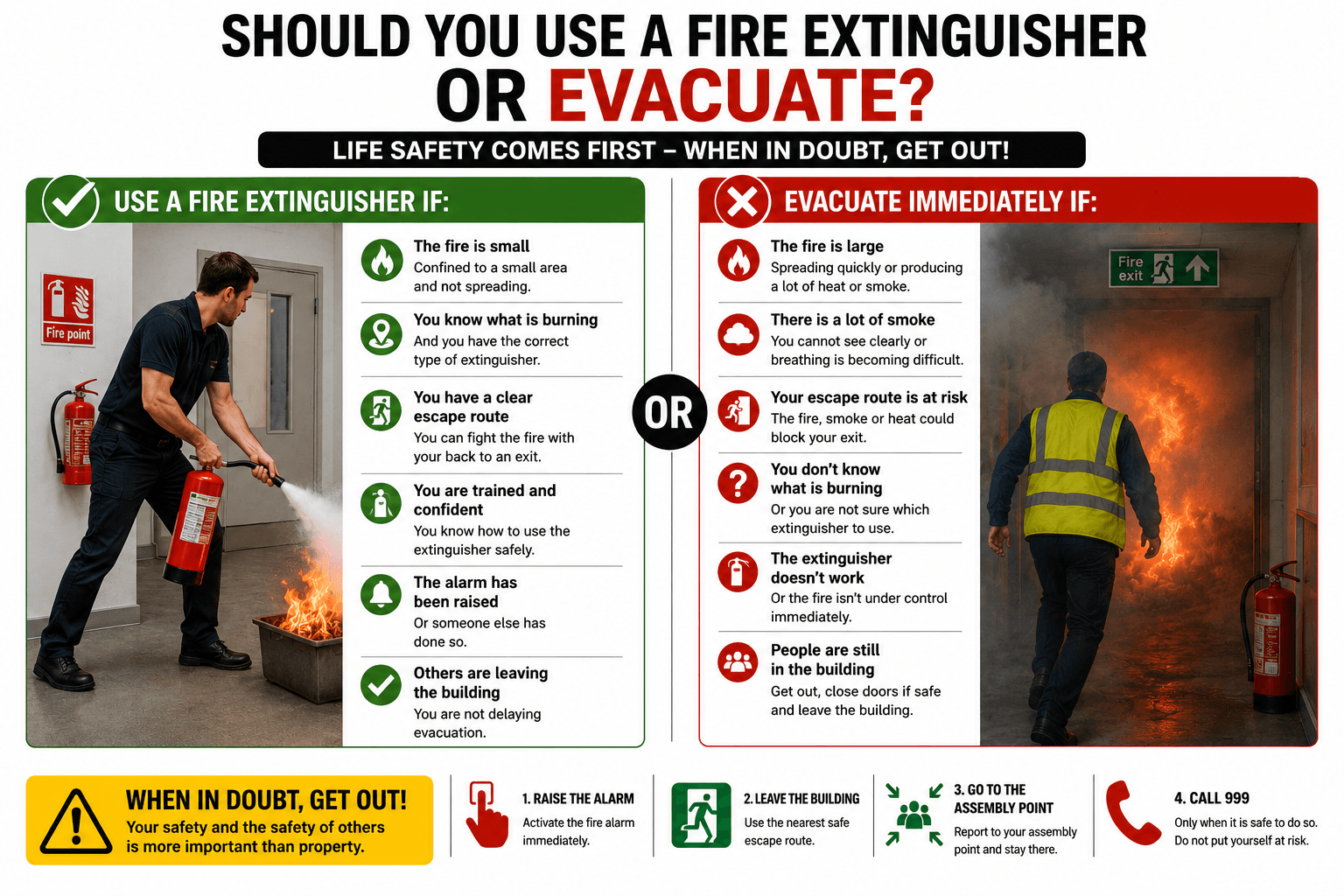
Use a Fire Extinguisher or Evacuate –
When a fire starts at work, the first few moments can be confusing.
An employee may see a small fire with an extinguisher mounted only a few metres away. Should they attempt to put the fire out, or should they immediately evacuate?
The answer shouldn’t be based on bravery or a desire to protect property.
Life safety comes first.
Portable fire extinguishers can be useful for dealing with appropriate fires at an early stage, but employees should never put themselves at unnecessary risk by attempting to fight a fire.
Understanding when NOT to use an extinguisher is therefore an important part of Fire Extinguisher Training.
Is an Employee Expected to Fight a Workplace Fire?
Employees shouldn’t assume that discovering a fire means they are personally responsible for extinguishing it.
The priority is to follow the organisation’s fire emergency procedures.
This will normally include raising the alarm and ensuring that evacuation takes place.
Whether an employee might consider using portable firefighting equipment will depend on factors including their training, the organisation’s procedures and the circumstances of the fire.
An extinguisher should never encourage somebody to remain in a dangerous situation when they should be leaving the building.
How Big Is the Fire?
Portable fire extinguishers are intended for appropriate fires at an early stage.
A fire that is already developing rapidly is a very different proposition.
Warning signs that conditions may be becoming too dangerous can include:
- Rapidly spreading flames.
- Significant heat.
- Increasing smoke.
- Fire spreading beyond the original item.
- Difficulty seeing clearly.
- An escape route becoming threatened.
- Uncertainty about what is burning.
An employee shouldn’t continue trying to extinguish a fire simply because they have already started.
Conditions can change quickly.
If an attempt isn’t immediately effective or the situation deteriorates, evacuation should take priority.
Always Consider Your Escape Route
Before somebody even considers using an extinguisher, they need to know that they can still get out safely.
Putting a fire between yourself and the exit can be extremely dangerous.
Smoke or flames could quickly prevent escape.
Employees should therefore understand the importance of maintaining a clear escape route behind them.
If the only way to reach the fire involves putting yourself in a position where escape could be compromised, attempting to use an extinguisher isn’t appropriate.
Has the Alarm Been Raised?
Trying to extinguish a fire shouldn’t delay raising the alarm.
Other people in the building need to know that a fire has been discovered so they can follow the appropriate emergency procedures.
An employee shouldn’t spend valuable time attempting to deal with a fire while colleagues elsewhere in the premises remain unaware of the danger.
The organisation’s fire procedures should make clear what employees are expected to do when a fire is discovered.
Do You Know What Is Burning?
Different fires can require different types of extinguisher.
Selecting inappropriate equipment can make a dangerous situation worse.
UK workplaces may contain extinguishers including:
- Water.
- Foam.
- Carbon dioxide (CO₂).
- Dry powder.
- Wet chemical.
The appropriate equipment depends on the materials involved and the environment.
An employee who doesn’t know what is burning or isn’t confident that the available extinguisher is suitable shouldn’t simply guess.
This is one reason why extinguisher training needs to cover more than the operating mechanism.
Don’t Assume Every Red Cylinder Does the Same Job
UK portable fire extinguishers generally have red bodies, with identification such as colour coding and labelling indicating their contents.
Employees need to recognise that extinguishers containing different agents aren’t interchangeable.
For example, equipment intended for one type of fire may be inappropriate for another.
Training can help employees understand the extinguisher types relevant to their workplace and the risks associated with incorrect selection.
What About Electrical Equipment?
Electrical equipment introduces another consideration when selecting firefighting equipment.
Employees shouldn’t simply reach for whichever extinguisher is closest.
They need to understand which equipment is suitable for the circumstances and follow their workplace procedures.
Where there is uncertainty, personal safety should take priority over attempting to save equipment.
A computer, machine or appliance can be replaced.
An employee shouldn’t take an unnecessary risk to protect it.
Smoke Can Be a Reason to Evacuate
People often focus on flames when thinking about fire, but smoke can present a major danger.
An apparently manageable fire can create smoke that makes remaining in the area unsafe.
Employees shouldn’t enter or remain in smoke-filled areas to use an extinguisher.
Likewise, they shouldn’t allow an extinguisher attempt to delay evacuation while conditions deteriorate around them.
The safest response may be to close doors where appropriate, evacuate and allow the Fire and Rescue Service to deal with the incident.
What If the Extinguisher Doesn’t Put the Fire Out?
Portable extinguishers contain a limited amount of extinguishing agent.
If an appropriate initial attempt doesn’t control the fire, an employee shouldn’t continue taking increasing risks.
They should withdraw and evacuate.
One dangerous mistake is becoming so focused on extinguishing the fire that the person fails to notice the situation changing around them.
Fire Extinguisher Training should reinforce the importance of recognising when to stop.
Should You Go Back for Another Extinguisher?
If the fire hasn’t been controlled and conditions are becoming unsafe, employees shouldn’t turn firefighting into a prolonged operation by repeatedly searching for additional extinguishers.
Portable extinguishers aren’t intended to turn employees into a substitute fire service.
Once the situation is beyond a safe initial response, evacuation is the priority.
Employees should follow their organisation’s procedures and leave the building.
What If You Haven’t Been Trained?
An employee who hasn’t received appropriate training shouldn’t assume they will be able to work everything out during an emergency.
Reading an extinguisher label while a fire is developing isn’t an effective replacement for understanding the equipment beforehand.
Employers should consider who may need extinguisher knowledge as part of their fire safety arrangements.
Depending on the workplace, this could include Fire Wardens, supervisors, managers, maintenance staff or a wider group of employees.
Training Shouldn’t Make People Overconfident
There is an important balance to strike.
Fire Extinguisher Training should give employees useful knowledge and confidence, but it shouldn’t create the impression that completing a course means they should tackle every fire.
Effective training should explain the limitations of portable firefighting equipment.
Employees should understand:
- Different fire types.
- Extinguisher identification.
- Suitable extinguisher selection.
- Basic operating principles.
- The importance of an escape route.
- When attempting to tackle a fire may be inappropriate.
- When to abandon an attempt and evacuate.
Knowing when to leave is a fire safety skill in its own right.
Fire Extinguisher Training and Fire Warden Training Are Different
Businesses shouldn’t automatically assume that appointing somebody as a Fire Warden means they have received everything they need to know about extinguisher use.
Fire Warden Training focuses on the employee’s wider role within workplace fire safety and evacuation arrangements.
Fire Extinguisher Training focuses more specifically on portable firefighting equipment and its safe use.
Depending on the organisation’s arrangements, an employee may benefit from both.
Make Workplace Procedures Clear
Generic training needs to be supported by information specific to the workplace.
Employees should know:
- How to raise the alarm.
- How to contact the emergency services where required.
- Which escape routes to use.
- Where the assembly point is.
- What firefighting equipment is provided.
- What their employer expects them to do during a fire.
Nobody should be trying to work out the company’s emergency procedure while an actual fire is developing.
Flexible Fire Extinguisher Training
Businesses may need to provide Fire Extinguisher Training to employees at different times as new starters join or responsibilities change.
Fire Extinguisher Training supplied on USB provides a reusable resource for delivering training in-house.
The USB contains training videos, question and answer test sheets, certificate templates and training record templates. It can be accessed using a compatible PC, laptop or Mac and reused whenever additional employees require training.
Online Fire Extinguisher Training provides another option for individual employees or organisations with workers based at different locations.

Final Thoughts
Should you use a fire extinguisher or evacuate?
There isn’t a sensible answer that says an employee should always do one or the other regardless of the circumstances.
Portable extinguishers can be useful for appropriate fires at an early stage when the person has suitable knowledge and can act without putting themselves at unnecessary risk.
But evacuation and life safety always take priority.
If the fire is spreading, smoke is increasing, the correct extinguisher isn’t available, the employee isn’t confident about what to do or their escape route could be compromised, they shouldn’t take unnecessary risks.
Fire Extinguisher Training isn’t simply about teaching people how to operate an extinguisher.
One of its most important lessons is recognising when not to use one.
