
When Is It Safe to Use a Ladder at Work?
Ladders and stepladders are used every day in workplaces throughout the UK. They are convenient, portable and suitable for many straightforward tasks.
However, working from a ladder involves working at height, which means employers need to consider whether a ladder is actually appropriate for the job.
This raises an important question: when is it safe to use a ladder at work?
Ladders aren’t automatically banned for workplace use, nor does every job at height require scaffolding or a powered access platform. The important issue is selecting suitable access equipment based on the task and the level of risk involved.
Can You Legally Use a Ladder at Work?
Yes.
UK work-at-height requirements don’t prohibit the use of ladders and stepladders.
However, employers need to manage work at height appropriately. Where work at height cannot be avoided, suitable equipment should be selected according to the nature of the task and the risks involved.
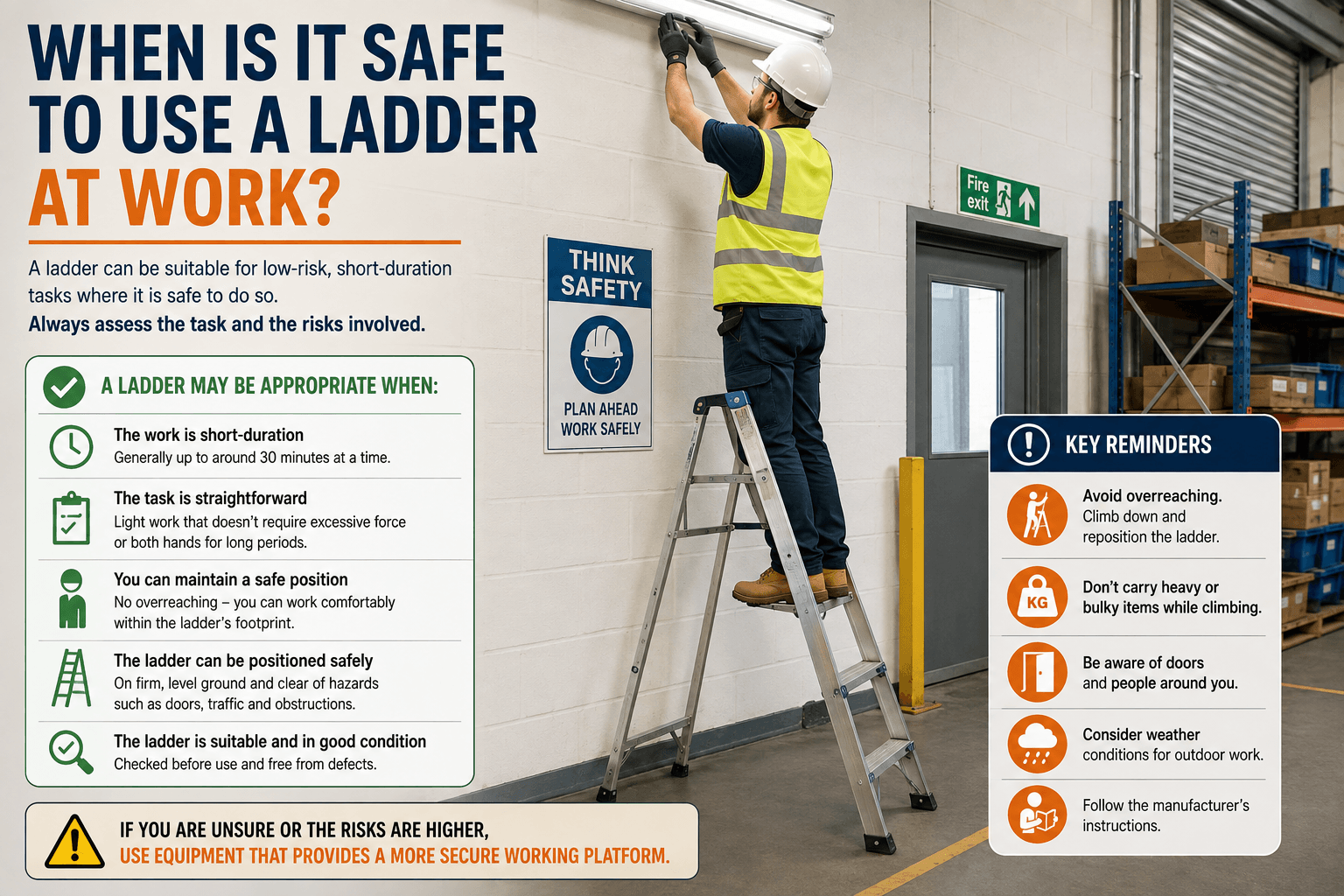
Ladders are generally more appropriate for lower-risk, relatively short-duration work where a risk assessment shows that equipment providing a higher level of fall protection isn’t justified.
The decision should be based on risk rather than convenience alone.

What Does Short-Duration Work Mean?
Duration is one consideration when deciding whether a ladder is appropriate.
HSE guidance uses work lasting up to around 30 minutes at a time as an indication of short-duration work when considering ladder use.
However, this isn’t a rule stating that every job lasting less than 30 minutes is automatically safe to perform from a ladder.
The complete task still needs to be considered.
A five-minute job requiring someone to lean dangerously sideways isn’t made acceptable simply because it is quick.
Consider the Task Being Performed
Before selecting a ladder, consider what the employee will actually be doing once they reach the working position.
Ask questions such as:
- How long will the task take?
- Does the employee need both hands for the work?
- Will significant force be required?
- Does the employee need to reach sideways?
- Are heavy tools or materials involved?
- Will the employee need to move frequently?
- Is the working position stable?
A ladder may be suitable for one task but completely inappropriate for another job at exactly the same height.
Can the Ladder Be Positioned Safely?
Even a suitable ladder can become unsafe if it can’t be positioned correctly.
The ground or supporting surface should be sufficiently firm, stable and suitable for the equipment.
Potential problems include:
- Uneven ground.
- Slippery flooring.
- Loose surfaces.
- Doorways.
- Vehicle routes.
- Pedestrian traffic.
- Obstructions.
- Areas where the ladder could be struck.
The surrounding environment therefore matters just as much as the ladder itself.
Why Overreaching Is Dangerous
One of the most common problems when using ladders is attempting to reach too far from the working position.
Rather than climbing down and repositioning the ladder, someone may stretch sideways to reach the final part of a task.
This can shift their centre of gravity and make the ladder unstable.
A simple principle is useful: if you can’t comfortably reach the work while maintaining a stable position, climb down and reposition the ladder.
Saving a few seconds isn’t worth increasing the risk of a fall.
What About Stepladders?
Stepladders are commonly used for indoor maintenance, stock handling and other relatively low-level tasks.
Before use, employees should check that the stepladder:
- Is suitable for the task.
- Is fully opened where required.
- Has functioning locking mechanisms.
- Is positioned on a suitable surface.
- Shows no obvious signs of damage.
Employees should also understand which steps or platform positions are intended for standing.
The manufacturer’s instructions should be followed.
Should You Work With Both Hands From a Ladder?
The need to maintain stability should form part of the assessment.
If a task requires an employee to work extensively with both hands, apply substantial sideways force or handle bulky materials, a ladder may not provide an appropriate working position.
Alternative access equipment may provide a more stable platform.
Again, the question isn’t simply whether someone can physically reach the job from a ladder.
It is whether they can carry out the work safely once they get there.
When Might Alternative Access Equipment Be Better?
Depending on the task, alternatives could include:
- Podium steps.
- Mobile access towers.
- Scaffolding.
- Mobile elevating work platforms.
- Other suitable access equipment.
The appropriate solution depends on the height, duration, environment and nature of the work.
For longer or more complex tasks, equipment providing a more secure working platform may be more suitable than a ladder.
Check the Ladder Before Using It
Selecting a ladder for an appropriate task is only part of the process.
The ladder itself also needs to be in suitable condition.
Employees should carry out an appropriate pre-use check and look for obvious problems involving components such as:
- Stiles.
- Rungs or steps.
- Feet.
- Hinges.
- Locks.
- Fixings.
If a ladder appears damaged, it shouldn’t simply be used carefully.
It should be taken out of service so that another employee doesn’t unknowingly use defective equipment.
What About Using Ladders Near Doors?
Doorways can create an additional hazard.
A person opening a door may not realise that someone is working from a ladder on the other side.
Where ladder work needs to take place near a door, suitable measures should be used to prevent the ladder being struck.
The precise solution will depend on the location and circumstances.
The important point is that employees should consider what other people are doing around them rather than concentrating solely on their own task.
Outdoor Ladder Work
Outdoor work introduces further considerations.
Weather conditions can affect whether ladder use remains appropriate.
Rain, ice and strong winds can all increase risk.
Ground conditions may also be less predictable than inside a building.
Employees shouldn’t feel pressured to continue with a task simply because the ladder has already been positioned.
If conditions change and the work can no longer be carried out safely, the task should be reassessed.
Why Ladder Safety Training Matters
Many ladder accidents aren’t caused by complicated technical failures.
They can result from everyday decisions such as:
- Using the wrong equipment.
- Failing to check the ladder.
- Positioning it poorly.
- Overreaching.
- Carrying unsuitable loads.
- Continuing to work in unsafe conditions.
Ladder Safety Training helps employees recognise these risks before they climb.
It can also reinforce an important principle: using a ladder safely begins with deciding whether a ladder should be used at all.
Flexible Ladder Safety Training
Businesses that regularly use ladders and stepladders may need to train new starters and refresh existing employees’ knowledge.
Ladder Safety Training supplied on USB provides a reusable resource for delivering training in-house. The package includes training videos, question and answer test sheets, certificate templates and training record templates.
The USB can be accessed using a compatible PC, laptop or Mac and reused when additional employees require training.
Online Ladder Safety Training provides another option for employees who need to complete their course individually or from different locations.
Final Thoughts
Ladders remain useful pieces of workplace equipment and can be entirely appropriate for many tasks.
The key is not to assume that a ladder is suitable simply because the work is above ground level and a ladder happens to be available.
Employers should consider the task, duration, working environment, equipment condition and whether the employee can maintain a safe working position.
Where a ladder is suitable, it should be positioned correctly, checked before use and used by someone who understands the relevant precautions.
Where it isn’t suitable, a different method of access should be selected.
Good Ladder Safety Training helps employees understand that distinction before they leave the ground.
