
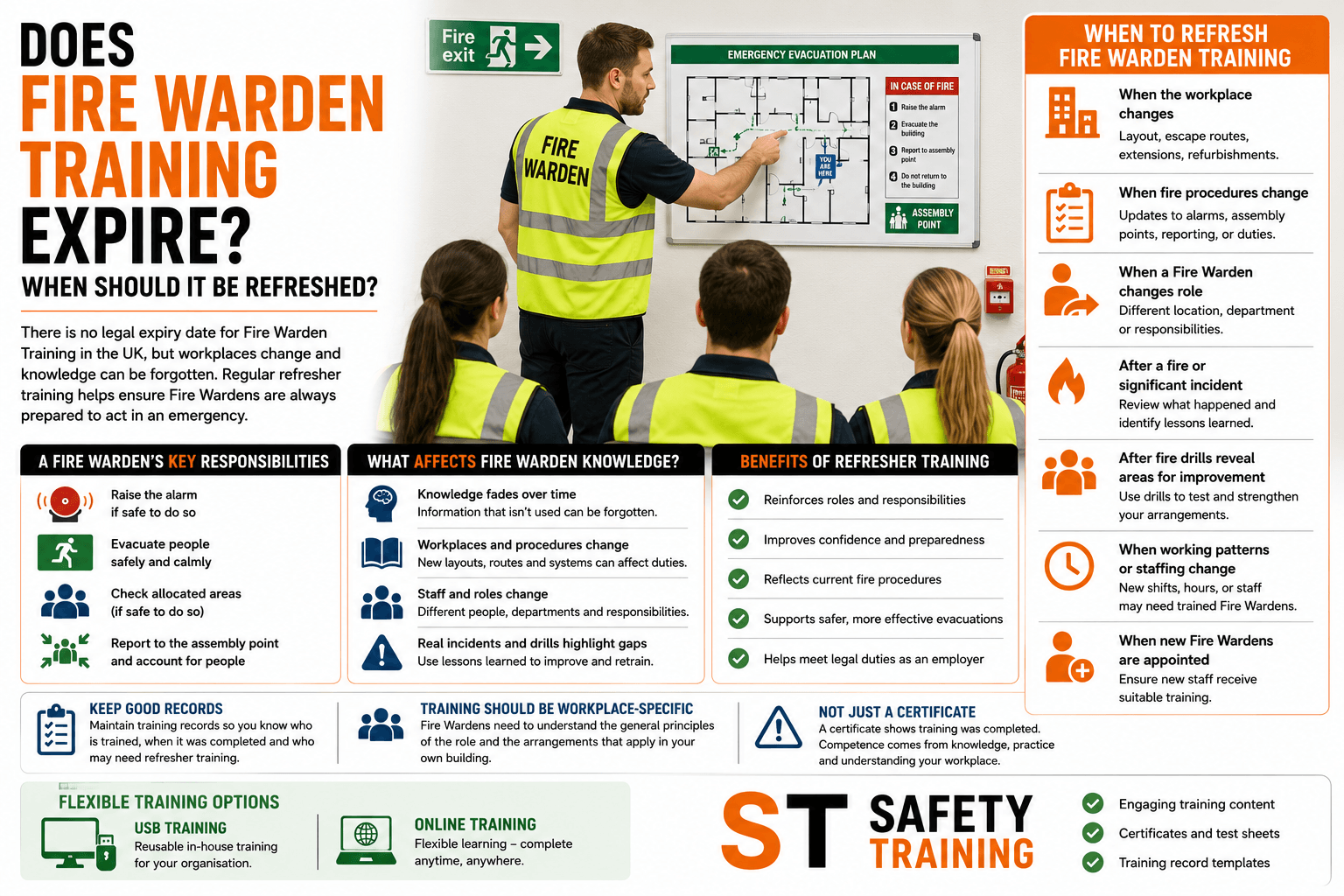
Does Fire Warden Training Expire?
If an employee completed Fire Warden Training several years ago, are they still suitably trained to carry out the role today?
It is an important question for UK businesses, particularly where employees were appointed as Fire Wardens some time ago and their original training has never been revisited.
So, does Fire Warden Training expire?
There isn’t a simple statutory expiry date that automatically makes a Fire Warden certificate invalid after a particular number of months or years. However, that doesn’t mean Fire Warden Training should be treated as a one-off exercise.
Workplaces change, people forget information and emergency procedures can be updated. Employers should therefore consider refresher training as part of maintaining effective fire safety arrangements.
Is There a Legal Expiry Date for Fire Warden Training?
UK fire safety legislation doesn’t prescribe a universal expiry period for Fire Warden Training.
You shouldn’t therefore assume that every Fire Warden certificate becomes legally invalid after a fixed period such as one, two or three years.
The more important question is whether the employee remains sufficiently knowledgeable and competent to perform the duties expected of them.
A certificate showing that someone attended training several years ago doesn’t necessarily demonstrate that their knowledge remains current.

Why Does Fire Warden Knowledge Need Refreshing?
Fire Warden Training covers information that an employee hopefully won’t need to use during a genuine emergency very often.
That’s obviously a good thing.
However, it also means some of the knowledge can gradually be forgotten.
An employee may remember the general principle of evacuating people from the building but be less certain about:
- Their specific responsibilities.
- Areas they are expected to cover.
- Current escape routes.
- Assembly procedures.
- Reporting arrangements.
- What to do if someone is unaccounted for.
- How to respond to particular fire hazards.
Refresher training can reinforce this knowledge before it is needed in a real emergency.
When Should Fire Warden Training Be Refreshed?
There isn’t one refresher interval suitable for every organisation.
Instead, employers should consider both periodic refresher training and additional training when circumstances change.
Several situations may indicate that Fire Warden knowledge should be reviewed.
When the Workplace Changes
A significant change to the building can affect existing fire procedures.
Examples include:
- Office refurbishment.
- Departments moving between floors.
- New extensions.
- Changes to escape routes.
- Alterations to fire doors.
- Different assembly arrangements.
- Changes to the way areas are used.
A Fire Warden trained using the previous layout needs to understand how those changes affect their responsibilities.
When Fire Procedures Change
Businesses periodically review and update their emergency arrangements.
If a change affects what Fire Wardens are expected to do, those employees need to know about it.
Simply updating a document isn’t sufficient if the people expected to implement the procedure remain unaware of the change.
Training and communication should reflect current arrangements.
When a Fire Warden Changes Role
Someone appointed as a Fire Warden while working in one department may later move elsewhere within the organisation.
Their new working location could have different:
- Escape routes.
- Fire hazards.
- Occupants.
- Evacuation arrangements.
- Areas requiring checking.
Their previous knowledge may therefore need updating.
After a Fire or Significant Incident
An actual fire, evacuation or significant fire-related incident provides an important opportunity to review existing arrangements.
Did people evacuate as expected?
Were Fire Wardens clear about their responsibilities?
Were any areas overlooked?
Was information communicated effectively at the assembly point?
If an incident exposes gaps in knowledge or procedure, refresher training may form part of the corrective action.
What Can Fire Drills Tell You?
Fire drills aren’t simply exercises that businesses need to get through as quickly as possible.
They can provide useful information about how well emergency arrangements work in practice.
A drill may reveal that:
- Employees don’t recognise the alarm.
- Escape routes aren’t being followed.
- People return to collect belongings.
- Assembly arrangements cause confusion.
- Fire Wardens aren’t certain which areas they should cover.
Where problems are identified, businesses can review their arrangements and consider whether additional instruction or refresher training is required.
What About New Fire Wardens?
When an existing Fire Warden leaves the organisation or changes role, another employee may need to take their place.
The replacement shouldn’t simply be handed a high-visibility vest and told what to do by a colleague.
They should receive suitable training so they understand the role and the organisation’s fire safety arrangements.
This is particularly important where staff turnover gradually changes the original group of trained Fire Wardens.
Don’t Forget Shift Patterns
Fire Warden provision should reflect when people are actually at work.
A business may have several well-trained Fire Wardens, but if they all work the same shift, other periods could have inadequate coverage.
Changes to:
- Working hours.
- Shift patterns.
- Hybrid working.
- Weekend staffing.
- Night working.
may therefore create a reason to review both the number of trained Fire Wardens and whether additional employees require training.
Fire Warden Training and Workplace-Specific Information
General Fire Warden Training provides employees with important knowledge about the role and principles of workplace fire safety.
However, businesses should also ensure Fire Wardens understand the arrangements that are specific to their own premises.
This can include:
- Escape routes.
- Assembly points.
- Alarm arrangements.
- Areas allocated to individual Fire Wardens.
- People who may require assistance.
- Reporting procedures.
The two elements work together.
Knowing the general responsibilities of a Fire Warden is useful, but employees also need to understand how those responsibilities apply within their own workplace.
Keeping Training Records
Maintaining appropriate training records helps employers keep track of who has received Fire Warden Training and when it was completed.
This can make it easier to identify:
- Employees who haven’t yet received training.
- New Fire Wardens.
- Staff who may benefit from refresher training.
- Gaps caused by employees leaving.
- Departments or shifts requiring additional coverage.
Good records are particularly useful for larger organisations where Fire Warden responsibilities are spread across multiple departments, buildings or shifts.
Making Refresher Training Easier
Businesses that regularly train new Fire Wardens or provide refresher sessions may benefit from having a reusable training resource available.
Fire Warden Training supplied on USB allows businesses to deliver training in-house when required. The package includes training videos, question and answer test sheets, certificate templates and training record templates.
The USB can be accessed using a compatible PC, laptop or Mac, making it practical for organisations that want to train employees at different times without arranging a separate external course for each new Fire Warden.
Online Fire Warden Training provides another option for employees who need to complete training individually or remotely.

Final Thoughts
Fire Warden Training doesn’t have one universal statutory expiry date that applies to every UK workplace.
But that shouldn’t be interpreted as meaning Fire Warden knowledge lasts indefinitely without review.
Changes to the building, employees, working patterns, fire procedures and identified risks can all affect what a Fire Warden needs to know.
Employers should therefore consider refresher training periodically and whenever circumstances indicate that existing knowledge may no longer be sufficient.
The objective isn’t simply to keep certificates current.
It’s to ensure that when the fire alarm sounds, the people given Fire Warden responsibilities understand what they need to do.
