
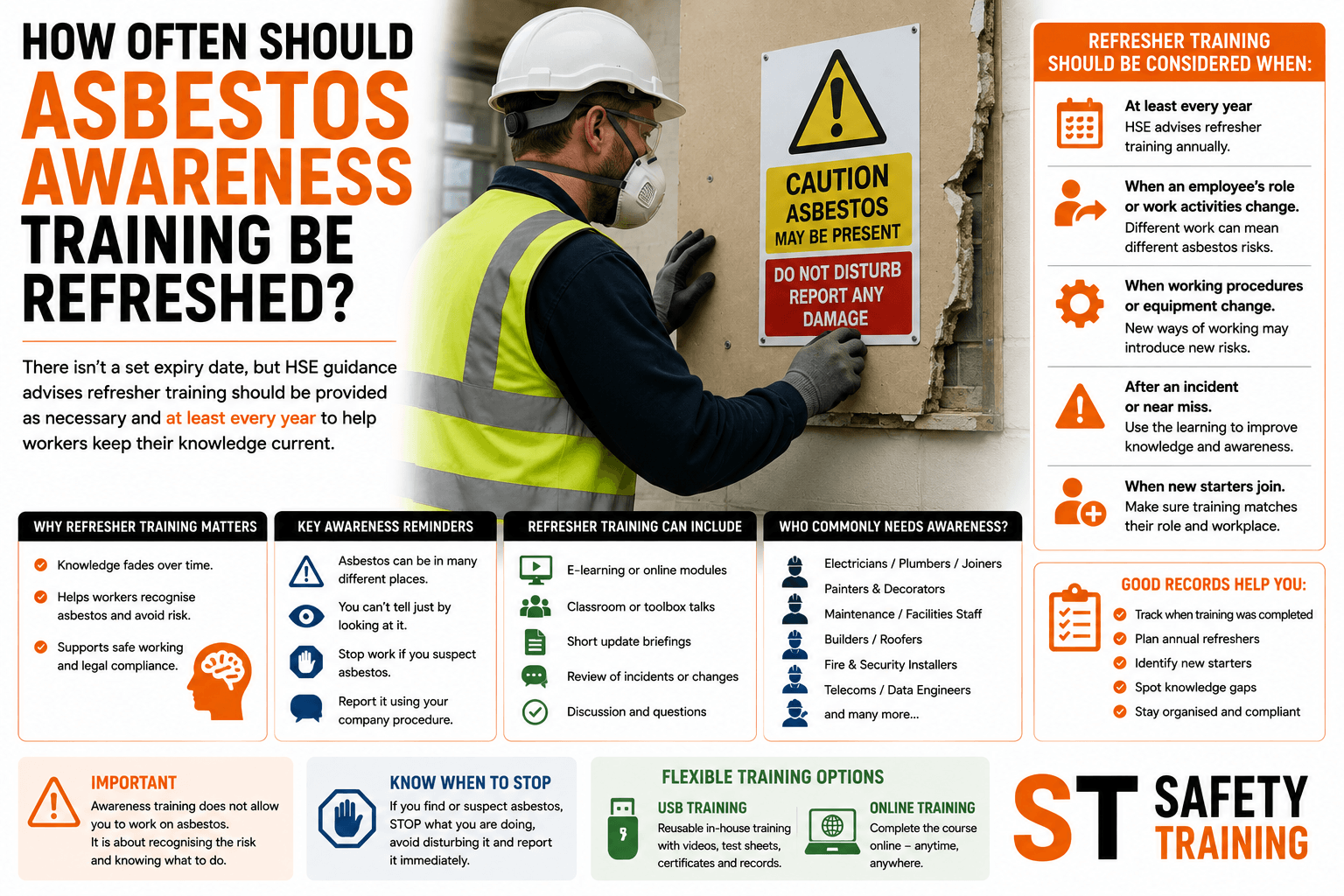
How Often Should Asbestos Awareness Training Be Refreshed?
Asbestos Awareness Training is important for employees who could encounter asbestos-containing materials during their work.
But once someone has completed the training, how long does that knowledge remain sufficient?
It leads to a common question from UK employers and contractors: how often should Asbestos Awareness Training be refreshed?
Unlike some qualifications, asbestos awareness doesn’t simply have a universal expiry date after which a certificate automatically becomes invalid. However, employers need to ensure workers maintain an appropriate level of awareness, and refresher training plays an important role in keeping that knowledge current.
Does Asbestos Awareness Training Expire?
There isn’t a single statutory expiry date that applies to every Asbestos Awareness Training certificate.
However, this shouldn’t be interpreted as meaning someone can complete awareness training once and remain adequately trained indefinitely.
The Health and Safety Executive (HSE) advises that refresher training for asbestos awareness should be provided as necessary to help ensure knowledge is maintained.
HSE guidance indicates that refresher training should be given at least every year. Importantly, this doesn’t necessarily mean repeating an entire formal awareness course every 12 months.
The appropriate refresher can reflect the worker’s existing knowledge and circumstances.

Why Does Asbestos Awareness Need Refreshing?
Asbestos awareness is primarily about preventing accidental exposure.
A worker needs to recognise situations where asbestos could potentially be present and understand what to do before they inadvertently disturb the material.
If someone completed training several years ago but remembers very little of it, the existence of an old certificate provides limited protection in a real working environment.
Workers need to retain key knowledge including:
- Why asbestos is hazardous.
- Where asbestos-containing materials may occur.
- Which work activities could disturb asbestos.
- Why asbestos can’t reliably be identified by appearance alone.
- The importance of checking relevant asbestos information.
- What to do when suspicious materials are encountered.
- What to do following accidental disturbance.
Refresher training helps keep these principles familiar.
Does Refresher Training Have to Be a Full Course?
Not necessarily.
HSE guidance allows refresher training to be proportionate to the worker’s training needs.
Depending on the circumstances, refresher information might be delivered through methods such as:
- E-learning.
- A structured training session.
- Toolbox talks.
- Short awareness presentations.
- Discussions of recent incidents or near misses.
- Updates concerning changes to working practices.
However, simply issuing workers with information and assuming they have understood it isn’t enough.
The objective should be to maintain an appropriate level of awareness.
When Might More Comprehensive Refresher Training Be Appropriate?
There may be circumstances where repeating more substantial training is appropriate rather than relying on a short update.
For example, consider an employee who completed Asbestos Awareness Training several years ago and hasn’t received any refresher information since.
They may struggle to remember important parts of their original training.
A fuller refresher may also be appropriate when:
- The employee’s knowledge appears inadequate.
- Their work activities have changed significantly.
- They are moving into a role with greater potential to encounter asbestos.
- Working procedures have changed.
- An incident or near miss has highlighted gaps in knowledge.
Employers should consider what employees actually need rather than treating refresher training as an administrative exercise.
Changes to an Employee’s Job
A change in role can substantially alter the likelihood of encountering asbestos.
An employee previously working mainly in new-build properties might move into maintenance work involving older premises.
Likewise, someone who previously carried out administrative work could move into a facilities or property-management role.
The employee may suddenly encounter very different risks.
Employers should therefore consider whether existing training remains appropriate when someone’s duties change.
Changes to Working Procedures
Businesses also change how work is organised.
New equipment, contractors, procedures and types of work can all affect asbestos risks.
For example, a maintenance team may begin carrying out work that was previously outsourced.
Employees could consequently encounter materials and parts of buildings they hadn’t previously worked around.
Training arrangements should reflect the work employees are actually performing today rather than the work they performed when they originally completed their course.
What About New Starters With Previous Training?
A new employee may arrive with an Asbestos Awareness certificate from a previous employer.
That doesn’t necessarily mean the new employer can simply assume nothing further is required.
It is sensible to consider:
- When the training was completed.
- Whether appropriate refresher training has been received.
- The employee’s current knowledge.
- The type of work they previously performed.
- How their new role differs.
- Workplace-specific asbestos arrangements they need to understand.
General awareness training and information specific to the employer’s premises and procedures are not necessarily the same thing.
Who Commonly Needs Asbestos Awareness Refresher Training?
Awareness training can be relevant to many occupations where employees could encounter asbestos during their work.
Examples can include:
- Electricians.
- Plumbers.
- Heating engineers.
- Joiners and carpenters.
- Painters and decorators.
- Builders.
- Roofers.
- Maintenance workers.
- Fire and security installers.
- Telecoms engineers.
- Facilities staff.
- Caretakers.
The important factor isn’t simply someone’s job title.
It is whether their work could foreseeably expose them to asbestos-containing materials.
Refresher Training Doesn’t Permit Work With Asbestos
This remains an important distinction.
Refreshing someone’s Asbestos Awareness Training doesn’t qualify them to intentionally work on asbestos-containing materials.
Awareness training is intended to help employees recognise and avoid the risk.
Workers who are expected to carry out work that could disturb asbestos require the appropriate level of additional information, instruction and training for that work.
In some circumstances, specialist licensed contractors may be required.
An up-to-date awareness certificate should never be treated as a licence to work with asbestos.
What Should Workers Remember Above Everything Else?
One of the most valuable outcomes of awareness training is knowing when to stop.
If a worker discovers a suspicious material during drilling, maintenance, installation or refurbishment work, continuing until somebody confirms it is asbestos is precisely the wrong approach.
Workers should understand their organisation’s procedures for stopping work, avoiding further disturbance and reporting the concern.
That decision could prevent an accidental release of asbestos fibres.
Keep Records of Asbestos Awareness Training
Employers should maintain appropriate records of training and refresher activity.
Good records can help identify:
- When employees were originally trained.
- When refresher training was provided.
- Who may now require an update.
- New starters requiring training.
- Gaps within particular teams.
- Employees whose roles have changed.
For businesses employing numerous tradespeople or maintenance personnel, this can make ongoing training considerably easier to manage.
Flexible Asbestos Awareness Training
Businesses that regularly need to train new employees or provide more comprehensive refresher training can benefit from having training readily available.
Asbestos Awareness Training supplied on USB provides a reusable in-house resource containing training videos, question and answer test sheets, certificate templates and training record templates.
The USB can be accessed using a compatible PC, laptop or Mac and reused when additional employees require training.
Online Asbestos Awareness Training provides another convenient option for individual employees, remote workers or businesses that don’t need their own reusable training resource.

Final Thoughts
Asbestos Awareness Training shouldn’t be regarded as something an employee completes once and then forgets about.
HSE guidance indicates that refresher training should be provided as necessary and at least annually to help workers maintain their awareness. That refresher doesn’t necessarily have to involve repeating the complete original course every year.
What matters is that employees retain the knowledge they need for the work they actually perform.
For businesses employing people who could encounter asbestos, keeping that knowledge fresh can help prevent a routine drilling, maintenance or refurbishment task from turning into an accidental asbestos exposure.
