
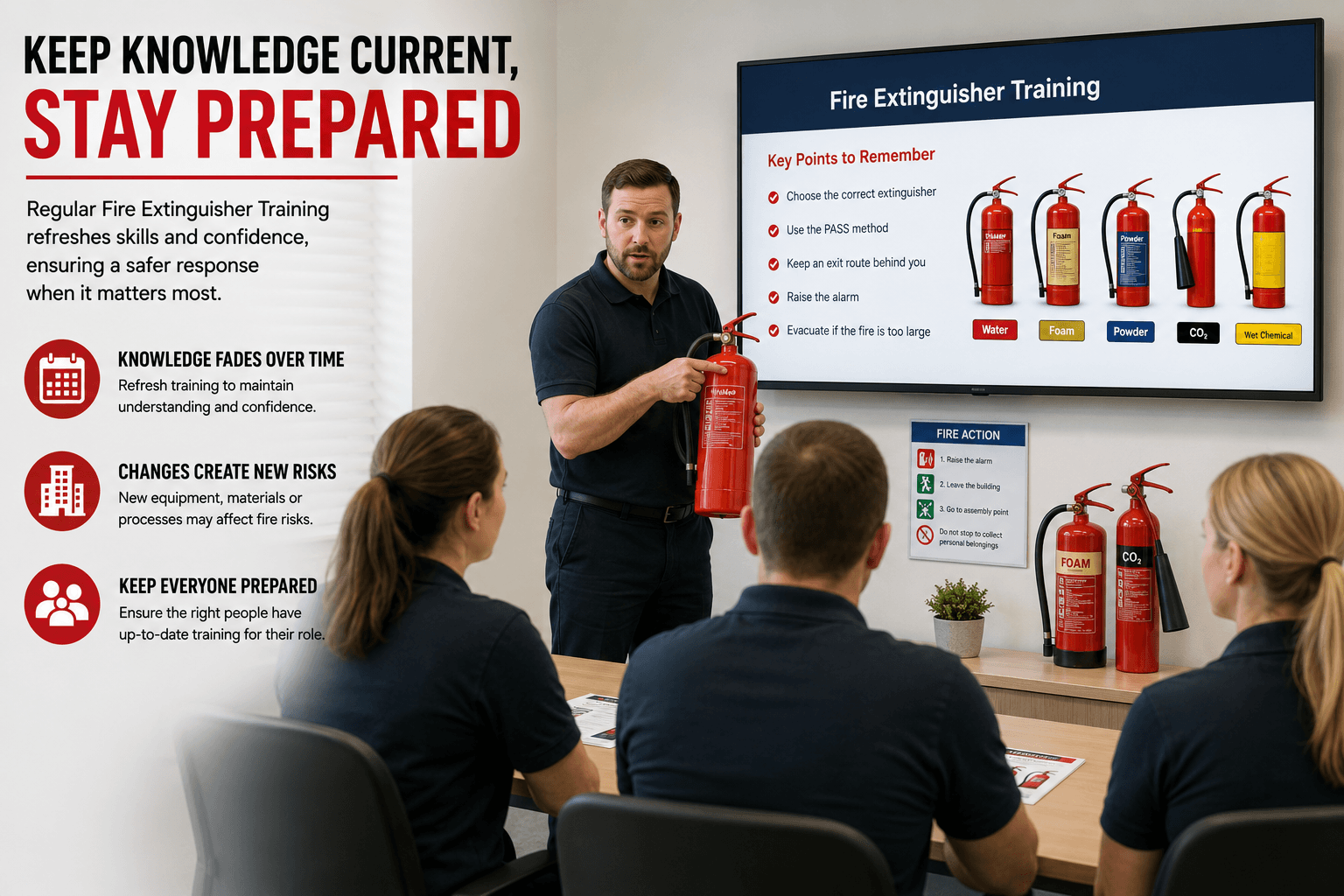
How Often Should Fire Extinguisher Training Be Refreshed?
Fire extinguishers are installed throughout UK workplaces, but knowing that an extinguisher is available and knowing how to respond appropriately during a fire are very different things.
Employees who have received Fire Extinguisher Training may understand which equipment to use, how it operates and when attempting to tackle a fire would be unsafe.
But what happens as that knowledge fades?
This raises an important question for employers: how often should Fire Extinguisher Training be refreshed?
There isn’t one universal statutory expiry date for Fire Extinguisher Training. Instead, employers should consider whether employees remain sufficiently informed and trained for the fire safety responsibilities they are expected to undertake.
Does Fire Extinguisher Training Expire?
Fire Extinguisher Training doesn’t automatically become legally invalid on a specific anniversary.
You shouldn’t therefore assume that every certificate expires after exactly one, two or three years.
However, this doesn’t mean an employee who completed training many years ago should automatically be considered adequately trained today.
Knowledge can deteriorate, workplaces can change and employees may rarely have an opportunity to apply what they originally learned.
Refresher training can help reinforce that knowledge.
Why Can Fire Extinguisher Knowledge Be Forgotten?
Most employees will hopefully never have to use a fire extinguisher during a genuine emergency.
That means there can be a considerable gap between completing training and needing to recall the information under pressure.
An employee may remember that different extinguishers exist but forget:
- Which extinguisher is suitable for a particular fire.
- How the equipment operates.
- Where to position themselves.
- Why an escape route must remain available.
- When a fire has become too dangerous to tackle.
- When evacuation should take priority.
These aren’t details you want someone trying to remember for the first time while standing near a developing fire.

When Should Refresher Training Be Considered?
The appropriate frequency will depend on the workplace, its risks and the employees involved.
There are, however, several circumstances where refresher training should be considered.
When Knowledge Has Faded
If employees struggle to remember which extinguishers are suitable for different types of fire, their original training is no longer providing the intended level of knowledge.
A refresher can reinforce the fundamentals.
When Fire Risks Change
Businesses evolve.
New machinery, equipment, processes or materials can introduce different fire risks.
A workplace that previously contained mainly ordinary combustible materials may later introduce equipment or substances requiring different firefighting considerations.
Training should reflect the risks employees actually encounter.
When Extinguisher Provision Changes
The type or location of portable firefighting equipment may change following a fire risk assessment, refurbishment or alteration to the premises.
Employees expected to understand extinguisher use should be made aware of relevant changes.
After a Fire or Near Miss
An incident can expose weaknesses in existing knowledge.
Perhaps an employee selected inappropriate equipment, hesitated because they weren’t sure what to do or attempted to tackle a fire when evacuation would have been safer.
Incidents and near misses should be reviewed, and additional training may be appropriate where gaps are identified.
What About New Employees?
New starters should receive suitable fire safety information as part of their induction.
Where their role or the organisation’s arrangements mean they require Fire Extinguisher Training, employers shouldn’t automatically rely on training completed with a previous employer.
The equipment, fire hazards and procedures at the new workplace may be different.
Previous experience can be useful, but employees still need to understand the environment in which they are currently working.
Is Knowing How to Operate an Extinguisher Enough?
No.
Operating the mechanism is only one part of Fire Extinguisher Training.
Employees also need to understand the decisions surrounding extinguisher use.
For example:
- Is the fire small enough to tackle safely?
- Is the correct extinguisher available?
- Is smoke creating a hazard?
- Is there a clear escape route?
- Has the alarm been raised?
- Is evacuation the safer option?
An employee who knows how to discharge an extinguisher but doesn’t understand when not to use it hasn’t received the complete safety message.
Refresher Training Should Reinforce Extinguisher Types
UK workplaces can contain several types of portable fire extinguisher.
These may include:
- Water.
- Foam.
- Carbon dioxide (CO₂).
- Dry powder.
- Wet chemical.
Different extinguishing agents are intended for different fire risks.
Employees don’t need to become fire safety specialists, but anyone expected to consider using an extinguisher should understand the equipment relevant to their workplace.
Refresher training can help maintain this recognition.
Fire Extinguisher Training and Fire Drills
Fire drills and Fire Extinguisher Training serve different purposes.
A fire drill primarily tests evacuation arrangements.
It can help employees practise:
- Responding to the alarm.
- Leaving the building.
- Following escape routes.
- Reaching the assembly point.
It doesn’t necessarily demonstrate that an employee understands portable firefighting equipment.
Businesses shouldn’t therefore assume regular fire drills remove the need to review extinguisher knowledge where employees are expected to have it.
Should Everyone Receive Refresher Training?
That depends on the organisation’s fire safety arrangements.
Some businesses provide extinguisher training to a broad group of employees. Others identify particular people who require more detailed knowledge.
These might include:
- Fire Wardens.
- Managers.
- Supervisors.
- Facilities personnel.
- Maintenance staff.
- Employees working around particular fire hazards.
The fire risk assessment and emergency arrangements should help determine the appropriate approach.
Don’t Forget Different Shifts
Training records can sometimes give a misleading impression of workplace coverage.
A business may have numerous trained employees, but if they all work during the same hours, other shifts may have little or no equivalent knowledge.
Employers operating evenings, nights or weekends should consider who is actually present during those periods.
Changes to shift patterns can also create a reason to review training arrangements.
Keeping Fire Extinguisher Training Records
Maintaining training records can help employers identify when employees originally received training and when refresher sessions have taken place.
This makes it easier to identify:
- Employees who haven’t received training.
- New starters.
- Staff whose training took place a long time ago.
- Departments requiring additional coverage.
- Changes caused by staff turnover.
Training records should support effective fire safety management rather than simply becoming paperwork that is filed and forgotten.
Flexible Refresher Training for Businesses
One challenge for employers is that employees don’t always require training at the same time.
A new employee may start this month, another may change role in six months and existing employees may require refresher training later.
Fire Extinguisher Training supplied on USB gives businesses a reusable training resource that can be accessed whenever required using a compatible PC, laptop or Mac.
The package includes training videos, question and answer test sheets, certificate templates and training record templates, making it suitable for organised in-house training.
Online Fire Extinguisher Training provides an alternative for employees who need to complete training individually or from different locations.

Final Thoughts
There isn’t a universal statutory expiry date for Fire Extinguisher Training that applies to every UK workplace.
Instead of relying solely on the date printed on a certificate, employers should consider whether employees still have the knowledge required for the responsibilities expected of them.
Changes to workplace risks, firefighting equipment, employee roles or working arrangements may all create a need for refresher training.
Most importantly, employees should remember that Fire Extinguisher Training isn’t intended to encourage unnecessary firefighting.
It should help people recognise the equipment available, understand its limitations and make a safer decision about whether a small fire can be tackled or whether they should evacuate.
When there is doubt, personal safety and evacuation come first.
